
Capabilities
Engineering support
We build to your drawing, and we read it first. Drawing review and design-for-manufacture feedback come with every quotation, from the welding coordinator and the production office that will run the job.
What it is
Every enquiry with a drawing is reviewed before a price is written. The review checks what decides the cost and the quality of a weldment: whether the joints can be welded in the position and sequence drawn, whether the weld preparations suit the plate thickness and the process, whether the tolerances are within EN ISO 13920 or need a tighter class, whether the finish specification can be met in our booths, and whether a robot can reach the seams that would benefit from it.
The feedback is design-for-manufacture, not design. Where a change would make the part cheaper, straighter or easier to inspect, it is proposed with the quotation and the drawing is changed only when the customer agrees. The welding procedure specifications for the job are issued under the IWE welding coordinator.
Files are accepted as STEP, DWG, DXF or PDF. A STEP model is unfolded for the laser nests in our office; a DXF is used as supplied.
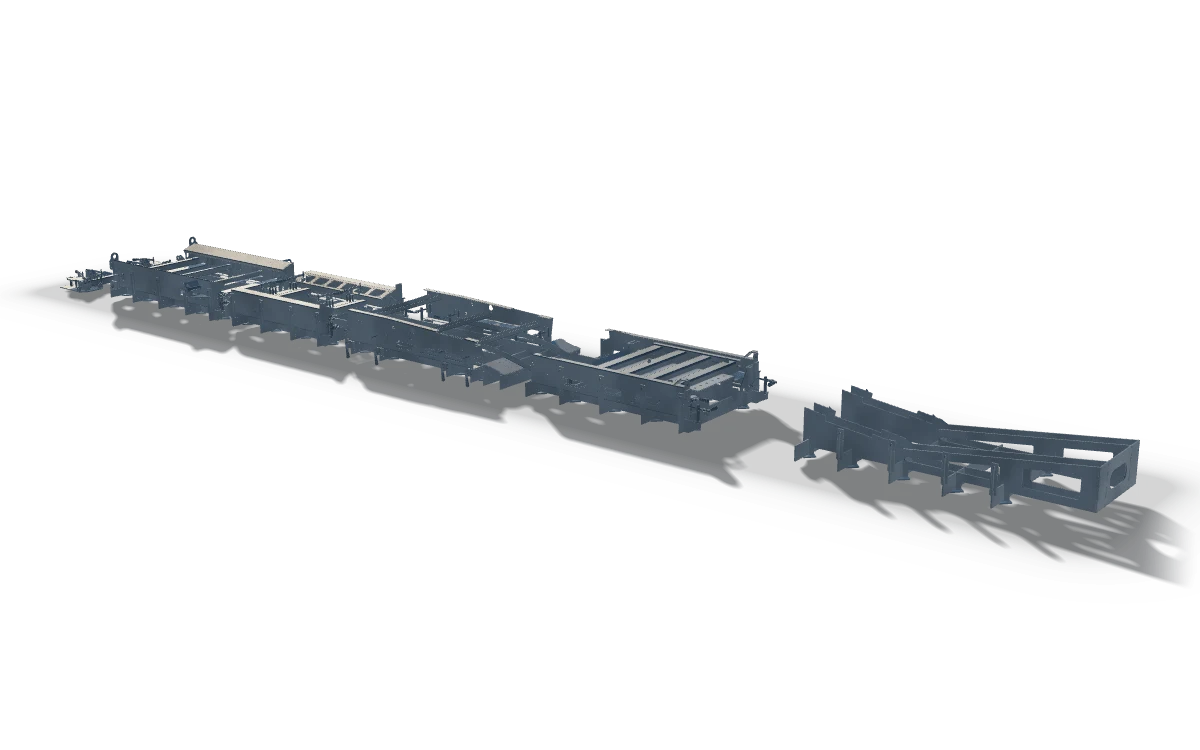
From the shop
Welding jig, 13.7 m
13 644 x 1 650 x 606 mm

The machine
One hall, and every process in it. Steel goes in at the laser and leaves through the paint booth without a subcontractor in between, which is why a lead time here is a queue rather than a haulage schedule.
Photograph published by TANAX TRUCKS a. s. on tanaxtrucks.com. Same company, same hall, our own material; no stock photography is used anywhere on this site.
What it is used for
- Weldability and weld-preparation review of the joints on the drawing
- Tolerance review against EN ISO 13920 and the drawing's own classes
- Machining allowances and datums on frames machined after welding
- Finish specification checked against the blasting and painting booths
- Unfolds and laser nests derived from the customer's STEP model
What it does not cover
- Structural design and calculation: design responsibility stays with the customer
- Product development or a drawing from a sketch: the hall builds to a drawing
- A CE declaration of performance under EN 1090-1: not offered, see the quality pages
- Certified design review or third-party approval: not offered
Anything not listed is quoted per enquiry, with the drawing.
What it means for you
This is manufacturing engineering, not design. We read the drawing, ask the questions it does not answer, and say where a change would make the part cheaper or more repeatable to build: a fold instead of two welds, a joint moved to where the press brake can reach, a tolerance relaxed where nothing needs it.
What it is not is design responsibility. We do not originate designs, we do not perform structural calculations, and we do not sign for the fitness of a design for its purpose. The drawing stays yours, the design stays yours, and a change we suggest is only ever a suggestion until you release it.
The standards that apply
There is no certificate for this and this site does not invent one; what governs it is what the review is done against.
- The customer's drawing and specification, which stay the governing documents throughout
- EN 1090-2 and EN ISO 5817, so a suggested change never moves the part outside the execution class it was drawn to
- ISO/TR 15608 groups 1 and 8, so a material substitution is never suggested outside the certified welding scope
- The published machine envelope, so a suggested change is always something this hall can actually make
- No design calculation, no structural verification and no design approval is offered or implied
Published figures
Engineering support carries no machine figure. The processes it prepares for are listed with their figures on the other capability pages.
The parent company publishes no machine figure for this capability. Scope and lead time are confirmed per enquiry.
Structure groups that rely on it
Drawing review matters most where a part is one of a kind, machined after welding, or folded from thin plate.


Questions about this process
- Will you design the part for us?
- No. We build to your drawing and we will tell you what would make it cheaper to build, but the design and the responsibility for it stay with you.
- Can you do the structural calculations?
- No. No structural verification is offered here, and no calculation is signed. Where a lifting beam or a platform needs one, it comes with your drawing.
- What do you do if the drawing is ambiguous?
- We ask before we cut. An ambiguity found at quotation costs an email; the same ambiguity found at inspection costs a part.
- Can you suggest changes that reduce cost?
- That is most of what this is. Typical ones: fewer weld runs by folding, a joint moved inside the press brake's reach, a general tolerance relaxed where the function does not need it, and a set of parts nested together rather than quoted one at a time.
- Do you keep our drawings confidential?
- Yes. Nothing a customer sends is published, and this site names no customer, no machine and no drawing number anywhere. The model gallery on the structure pages is anonymised for exactly that reason.
Anything not answered here is answered by return of email. Send the drawing with the question and the answer comes back against your part rather than in general.
Where this fits
Engineering support sits before every other capability, and it is where a first order usually starts.
Start here
Send the drawing. We answer with a price and a date.
STEP, DWG, DXF, PDF or ZIP, up to five files. Your drawings stay private: they are stored outside the web server and read only by our engineers.