
Conveyor and handling structures
Truss frames, supports, transfer structures.
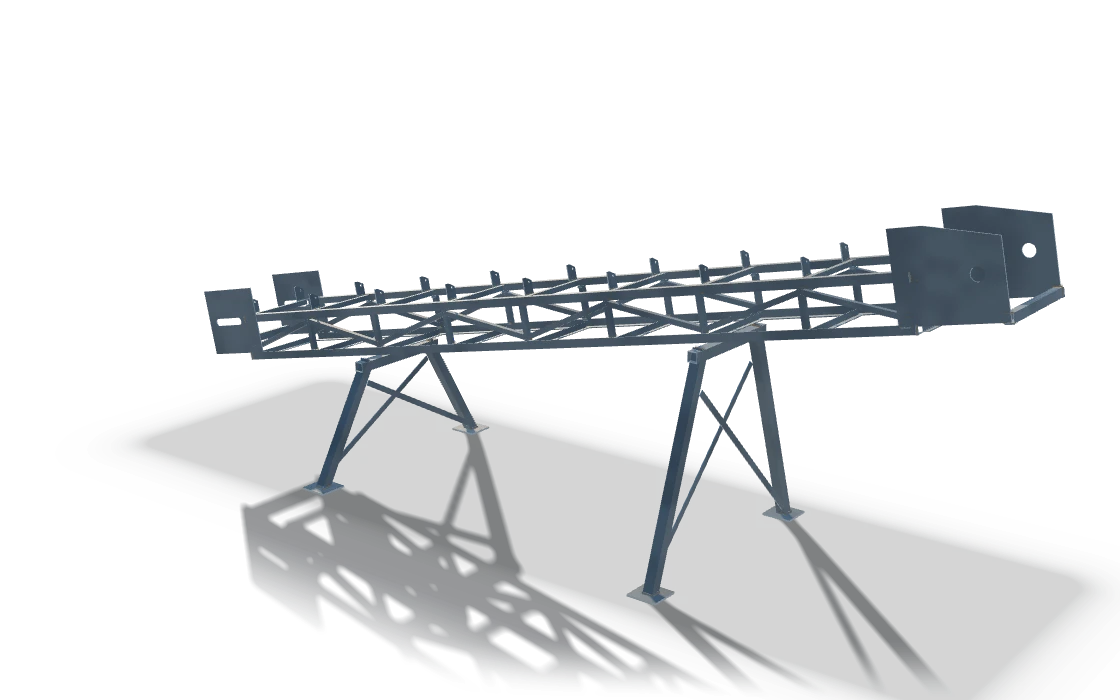
Parametric model of a typical piece. Your structure is built to your drawing, not to this shape.
What it is
The steel a conveyor runs on: truss or channel stringers, drive-end and tail-end frames, leg supports, cross bracing, transfer chutes and the walkway brackets beside the belt. Welded material conveyors are a named product type on our EN ISO 3834-2 certificate.
We fabricate the structure. Idlers, belts, drives and electrics are fitted on request when the customer supplies or specifies them; the structure is built so that they fit.
Typical pieces
- Truss and channel stringer sections with idler brackets
- Drive-end and tail-end frames with take-up slots
- Leg supports, cross bracing and base plates
- Transfer towers, chutes and hopper frames
- Boom sections for mobile stacking conveyors
Typical applications
The steel that carries a belt, and the steel around it that a maintenance crew stands on.
- Stringer sections for troughed belt conveyors, with idler brackets set to the belt pitch
- Drive-end and tail-end frames with take-up slots and bearing mounts
- Leg supports, cross bracing and base plates for elevated runs
- Transfer towers, chutes and hopper frames where two belts meet
- Boom sections for mobile stacking and radial conveyors
- Walkway and handrail brackets welded to the stringer rather than bolted on site
What we make
Conveyor steel is long and repetitive, and it is built in sections that bolt together on site.
- Truss and channel stringers in transportable sections with matched bolted splices
- Idler brackets and stringer holes laser cut, so pitch comes off the drawing and not off a tape
- Continuous fillet welds on the load path, laid by the robot where the section allows
- Blasted to Sa 2½ and painted, or detailed for hot-dip galvanising with venting and drainage
- Trial assembly of adjoining sections before dispatch when the order asks for it
Measured across the 22 pieces of this group in the gallery below: 1.5 to 14.6 m in the longest dimension, and most of them between 2.5 and 10.1 m. The tallest is 3.9 m and the widest 8.4 m.
Those figures are measured from the pieces in the gallery on this page, not a capacity limit. What the machines take is on the capability pages, and anything outside that is agreed per enquiry.
Mass is not published here. It follows the plate thicknesses the drawing sets, and we do not estimate it from a model. Send the drawing and the mass comes back with the quotation.
What we can make
Long, repetitive weldments suit the 14 m robotic welding track. Sections are sized to the blast chamber and paint booth so they leave the hall finished.
| Item | Machine | Figure |
|---|---|---|
| Laser bed | TRUMPF TruLaser 3040 | 2 000 x 4 000 mm |
| Press brake table length | DURMA AD-S 60400 | 6 050 mm |
| Press brake force | DURMA AD-S 60400 | 400 t |
| Structural steel, certified thickness (ISO/TR 15608 group 1) | EN ISO 3834-2 scope | up to 40 mm |
| Weld quality level (EN ISO 5817) | EN 1090-2, EN ISO 5817 | level C at EXC2 |
| Robotic welding track | Dual robotic welding station, Daihen FD-B6L | 14 m |
| Blasting chamber | Compressed-air blasting chamber | 8 000 x 5 000 x 3 000 mm |
| Spray and curing booth | Polin AC spray and curing booth | 7 900 x 5 000 x 4 890 mm |
Finish
Blasted to Sa 2½ and wet-painted in house. Hot-dip galvanising for outdoor structures on request, with the design detailed for venting and drainage.
- Raw steel, as welded · Default finish
- Wet paint, primer and top coat
- Hot-dip galvanised
Materials
S235 and S355 for stringers, legs and bracing, both ISO/TR 15608 group 1 and welded up to 40 mm under the certificate. Wear liners in chutes and transfer boxes are fitted to the drawing; the liner grade is the customer's call and is quoted as supplied material.
- S235 and S355 structural steel, ISO/TR 15608 group 1, welded up to 40 mm under the certificate
- Austenitic stainless steel, ISO/TR 15608 group 8, welded 3 to 16 mm
- Plate, hollow section, angle, channel and flat bar, cut and formed in house
- Material certificates to EN 10204 3.1 when the order asks for them
- Aluminium is outside the certified welding scope and is not offered
Welding
Welded material conveyors are a named product type on the EN ISO 3834-2 certificate. The runs are long and identical, which is what the 14 m robot track is for; a stringer is welded down one side, indexed and welded down the other without leaving the station.
- MAG 135, manual and robotic; the robotic stations run on a 14 m track
- Welding quality system certified to EN ISO 3834-2, certificate W348721, PQM s.r.o.
- Execution class EXC2 to EN 1090-2 unless the drawing calls for more
- Weld quality level C to EN ISO 5817, the level EN 1090-2 assigns to EXC2
- Procedures to EN ISO 15609-1, qualified to EN ISO 15614-1, welders to EN ISO 9606-1
- Welding coordination by an International Welding Engineer
Surface treatment
Conveyor steel usually lives outdoors, so it is blasted to Sa 2½ and painted in house, or detailed and sent out for hot-dip galvanising. Galvanising changes the drawing, not just the finish: vent and drain holes have to be in the design before the section is welded shut.
- As welded, deslagged and cleaned, where the drawing asks for nothing more
- Blasting to EN ISO 8501-1 Sa 2½ in the compressed-air chamber, 8 000 x 5 000 x 3 000 mm
- Wet paint in the Polin booth, 7 900 x 5 000 x 4 890 mm, cured at 75 to 80 °C
- Primer and top coat to the system the drawing specifies
- Hot-dip galvanising on request, through a partner; there is no bath in this hall
- Powder coating is not offered
Inspection and documentation
What matters on a conveyor section is that the next one bolts to it. Splice hole patterns, stringer straightness and the squareness of drive-end frames are checked before dispatch, to EN ISO 13920 with the class the drawing sets, and adjoining sections are trial assembled when the order asks.
- Visual testing of every weld to EN ISO 17637, assessed against EN ISO 5817
- Dimensional inspection to EN ISO 13920; the tolerance class is agreed on the drawing
- Measurement with a FARO Arm Prime 10 where the drawing needs a report
- Welding procedure specifications and their qualification records with the delivery
- Welder qualifications to EN ISO 9606-1
- Ultrasonic, magnetic particle and penetrant testing on request
- Coating thickness reports on request
What does not ship is an EN 1090-1 declaration of performance. TANAX TRUCKS a. s. publishes no EN 1090-1 factory production control certificate, so this site does not claim one; EN 1090-2 is the execution standard the welding system works to.
What we need from you
A conveyor structure is quoted section by section. Send, per section:
- The drawing, as PDF, and as STEP, DXF or DWG where you have it
- The material specification, grade by grade
- The weld quality level or the execution class, if the drawing does not carry it
- The finish: as welded, blasted, primed, painted to a system, or galvanised
- The quantity, and whether it is a one-off, a batch or a repeat call-off
- The date you need it on site, and the delivery address
A drawing is enough to quote from. Nothing here needs a specification written first.
The route through the hall
- 01
CNC laser cutting
Plate to 20 mm on a 2 000 x 4 000 mm bed, 3 200 W. Nests are cut from the customer's DXF or from our own unfolds.
- 02
CNC bending
400 t press brake with a 6 050 mm table and 365 mm stroke. Long folds in one hit; cones and boxes for hoppers and housings.
- 03
Welding
MAG 135, manual and robotic. A dual robotic station on a 14 m track and a second robotic cell with 2 008 mm reach, under an EN ISO 3834-2 system with an IWE welding coordinator.
- 04
Blasting and painting
An 8 000 x 5 000 x 3 000 mm compressed-air blasting chamber on rails into a 7 900 x 5 000 x 4 890 mm spray and curing booth, wet paint cured at 75 to 80 °C.
- 05
Inspection
Visual weld inspection under the welding coordinator and dimensional measurement with a six-axis FARO Arm Prime 10.
- 06
Assembly
Sub-assemblies, components and complete units assembled and fitted before dispatch.
From the shop
From the shop
Structures that have left this hall, shown as anonymous models: the geometry we welded, its real overall size, and nothing that identifies whose drawing it was.
22 models
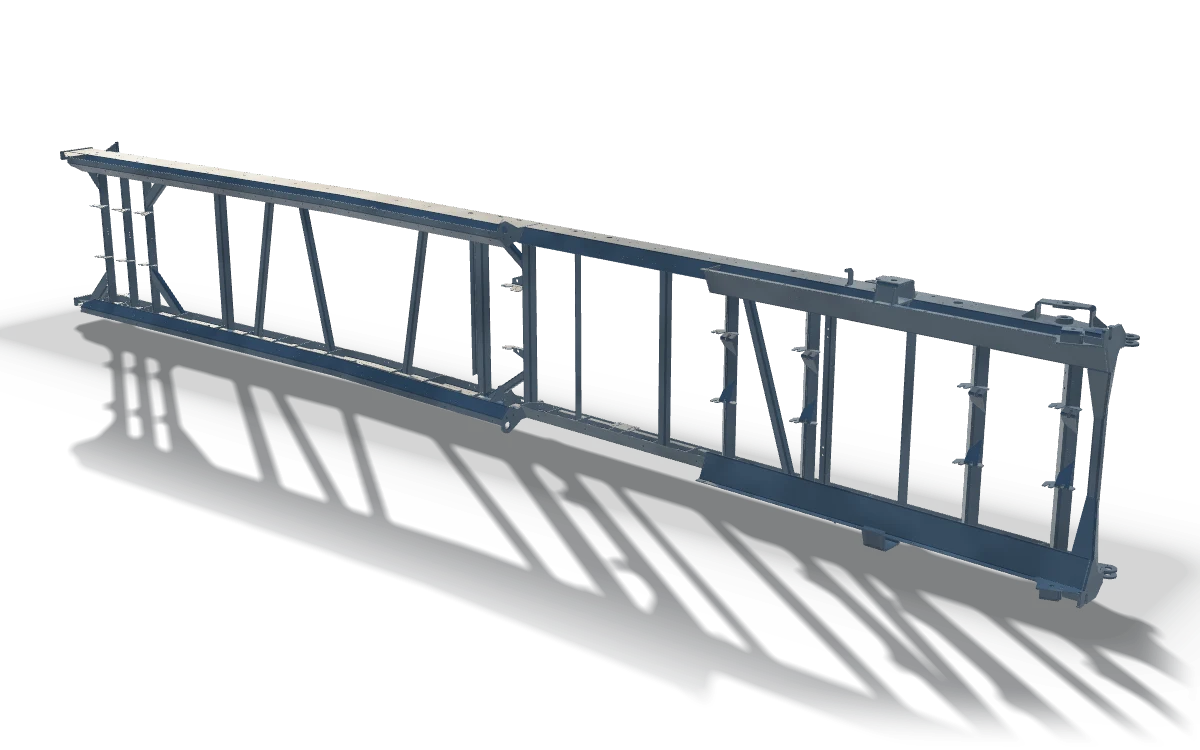


Each model is rendered from the production geometry in raw steel, without paint, and is shown as a still. Customer names, machine designations and drawing numbers are not published; part lists and files are not offered. The interactive model above this section is a parametric example, not one of these.
Where this fits
Conveyor steel is cut, formed, welded and finished; it is bought by construction and demolition plant builders and by material handling integrators.
Questions we are asked before a first order
- What steel do you weld?
- The certified welding scope is ISO/TR 15608 group 1, unalloyed and fine-grain structural steels up to 40 mm, and group 8, austenitic stainless from 3.0 to 16.0 mm. S235 and S355 are the grades we work most and both sit in group 1. Aluminium is outside the certified scope and is not offered.
- To what weld quality do you work?
- Execution class EXC2 to EN 1090-2, which assigns weld quality level C to EN ISO 5817, under our certified EN ISO 3834-2 welding quality system. Welding is MAG 135, manual and robotic. If your drawing calls for level B, say so on the drawing and we will price it.
- Can you paint or galvanise it?
- Wet paint, in our own line: a blasting chamber rail-connected to a spray and curing booth, so a piece is blasted and painted without leaving the building. Powder coating is not offered. Galvanising is on request.
- What do you need from me to quote?
- The drawing, as STEP, DWG, DXF, PDF or ZIP; the material specification; the weld quality class if it is not the standard one; the finish; the quantity or the series size; and the date you need it. A 2D drawing is enough to start.
- How big a piece can you take?
- The published machine figures are in the envelope table on this page and in full on the capabilities page: the laser bed, the press brake, the boring mill travels, the blasting and paint booths. Crane capacity, maximum weldment size and mass, and transport limits are not published by the parent company and are confirmed per enquiry rather than estimated here.
- Can a conveyor frame be galvanised?
- On request. This group ships raw, painted or galvanised: painting is done in our own blast and spray line, galvanising is arranged on request rather than done in the hall. Say which you want on the enquiry, because a galvanised frame wants its vent and drain holes designed in, not drilled afterwards.
Anything not answered here is answered on the enquiry, not estimated on this page.
Start here
Send the drawing. We answer with a price and a date.
STEP, DWG, DXF, PDF or ZIP, up to five files. Your drawings stay private: they are stored outside the web server and read only by our engineers.