
· 7 min read
600 mm or module 13: the limits of hobbing a gear in-house
The KNC 60 hobs gears up to 600 mm across the tips, from module 2 to 13, up to 110 mm wide and with 5 to 120 teeth. Each limit decides whether a gear is cut beside the frame it drives or goes to a second supplier.
A conveyor drive or a machine frame often carries a single gear, and that gear can decide who builds the whole order. The KNC 60 in our hall hobs gears up to 600 mm in diameter, from module 2 to 13. The face can be up to 110 mm wide, with 5 to 120 teeth. Those four limits are the whole of the gear hobbing capacity. A gear inside all four is cut beside the frame it drives. A gear outside any one of them goes to a gear shop, and the order gains a second supplier and a second delivery.
Diameter: the tooth tips have to clear 600 mm
The 600 mm limit applies to the outside diameter of the blank, measured across the tooth tips. The pitch diameter on the drawing is smaller, so a gear can look inside the limit and still be too large. Check the tip diameter first. If it is 600 mm or less, the teeth can be cut here.
Pitch diameter is the module times the number of teeth. On a standard tooth, the tip sits one module outside the pitch circle, on both sides of the gear. A coarse module therefore reaches 600 mm with far fewer teeth than a fine one. Change the module or the tooth count, and the tip diameter moves with it.
A wheel over 600 mm does not take the rest of the order with it. Its pinion can still be hobbed here, and the frame can still be built as one of our welded machine frames with its bores machined. Both gears of a pair share one module, so check the pinion and the wheel together.
Module: 2 to 13 on the machine, 5.5 to 6.5 on the hobs today
The KNC 60 accepts any module from 2 to 13. It currently runs modules 5.5 to 6.5, and a gear in that band starts on a hob already in use. A module elsewhere in the 2 to 13 range is within the machine but needs its own hob. Ask on the quotation whether that hob is in stock. If it is not, the tool sets the start date, not the machine.
A module finer than 2 or coarser than 13 goes out, whatever the diameter. If the design is still open, a module between 5.5 and 6.5 keeps both the machine and the tool out of the lead time.
Face width and tooth count: 110 mm and 5 to 120 teeth
The hob feeds across the face of the blank, and that feed stops at 110 mm. A gear with a wider face does not fit the KNC 60. Wide faces appear on heavily loaded drives, where the designer spreads the load along the tooth. If the face is wider than 110 mm, ask whether a coarser module on a narrower face carries the same load. That change can bring the gear back inside the machine, provided the tips still clear 600 mm.
Tooth count runs from 5 to 120. A pinion with fewer than 5 teeth goes out, and so does a wheel with more than 120. Between those, the diameter usually decides first. At module 5.5, 120 teeth already put the tips beyond 600 mm.
| Limit on the KNC 60 | Value | What falls outside |
|---|---|---|
| Diameter over the tooth tips | up to 600 mm | Larger wheels go to a gear shop |
| Module range of the machine | 2 to 13 | Finer or coarser teeth go out |
| Module running today | 5.5 to 6.5 | Other modules wait for a hob |
| Face width | up to 110 mm | Wider faces go out or are redesigned |
| Number of teeth | 5 to 120 | Smaller pinions and larger wheels go out |
The blank: which lathe turns it before the hob
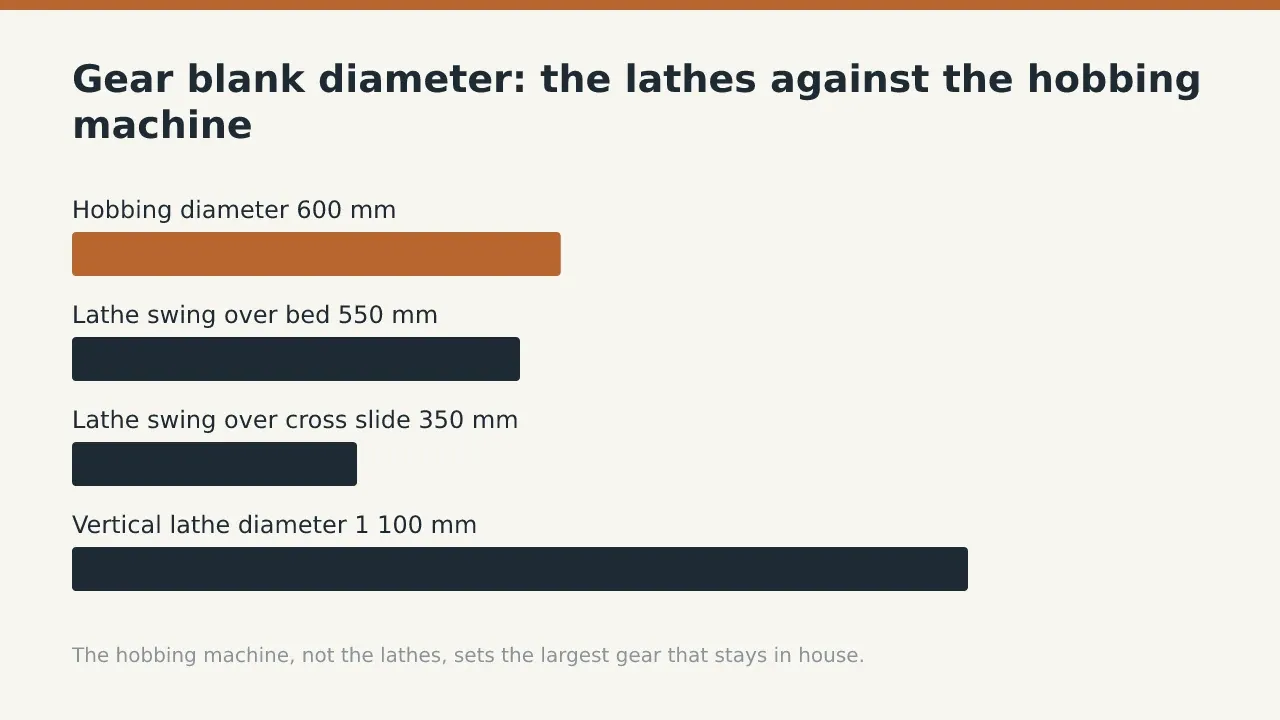
The blank is turned before any tooth is cut, and its diameter decides which lathe turns it. A short disc up to 550 mm swings over the bed of the MAS Masturn 550i CNC lathe. A longer blank, such as a pinion on its own shaft, is limited to 350 mm over the cross slide. Blanks between 550 mm and the 600 mm hobbing limit go to the SKIQ 8 CNC vertical lathe.
The SKIQ 8 turns up to 1 100 mm on an 800 mm table, so a 600 mm blank clamps flat with no overhang. Its limits of 765 mm in height and 2 500 kg sit far above any blank the KNC 60 takes. For gears, the vertical lathe is not the limit. The hobbing machine is.
Turning, hobbing and boring sit together under our machining capabilities for steel parts, so one drawing carries the part through all three.
How a gear blank becomes a hobbed gear
Every gear on the KNC 60 follows the same route. The blank is the step most likely to spoil it.
- Turn the blank to its tip diameter, bore and both faces, on the MAS Masturn 550i up to 550 mm or on the SKIQ 8 above that.
- Measure the turned blank. The inspector checks the tip diameter, the bore and the faces against the drawing, because a bore off centre puts runout into every tooth.
- Mount the blank on the KNC 60 with the bore as the datum, the same datum the gear runs on in the drive. The setter clocks the face true before the first cut.
- Hob the teeth. Hob and blank turn together in the ratio set by the tooth count, while the hob feeds across the face, up to 110 mm.
- Check the teeth against the tooth data on the drawing before the gear is unclamped.
- Deburr the tooth ends, oil the flanks and pack the gear with the frame it drives.
After hobbing, the gear joins the frame on the steps from drawing to delivered part that every order follows.
What to send so the gear stays with the frame
A gear is quoted against four values: tip diameter, module, face width and tooth count. Put them in a gear data table on the drawing, with the accuracy grade and the standard it refers to. State whether the teeth are straight or helical. If the teeth must be hardened or ground after hobbing, write that on the drawing too. The quotation then shows where that step is done. The rest of the drawing follows what a drawing needs before a quote, the same as for any welded part.
The gear is only as good as the bores that carry it. The centre distance between two gears is set by the bearing bores in the frame, not by the gears. On a frame up to 6 200 x 3 000 x 1 600 mm, those bores are cut on the TOS Varnsdorf WRD15 after welding. The gear mesh and the frame then share one drawing and one set of measurements. The sequence for that work is in boring the bearing seats after welding. Heavier frames are matched to a machine table in choosing a boring mill by frame weight.
Before you send the drawing, check each gear against the table above: tip diameter, module, face width and tooth count. If all four fall inside, send the gear with its frame and ask for one quotation covering both.
FAQ
What is the largest gear you can hob?
The KNC 60 hobs gears up to 600 mm in diameter over the tooth tips, with a face up to 110 mm wide.
Which gear modules can you cut?
The machine covers module 2 to 13 and currently runs 5.5 to 6.5. Any other module in that range needs its own hob before cutting starts.
How many teeth can a hobbed gear have?
Between 5 and 120 teeth, as long as the tip diameter stays within 600 mm. At module 5.5, 120 teeth already exceed that diameter.
Can you turn the gear blank as well?
Yes. Blanks up to 550 mm are turned on the MAS Masturn 550i, and larger blanks up to the 600 mm hobbing limit go on the SKIQ 8 vertical lathe.
Can the gear and its frame come on one order?
Yes. The frame is welded, and its bearing bores are machined after welding on travel up to 6 200 x 3 000 x 1 600 mm.
Send the gear drawing together with its frame through the quotation page, and the reply will state which parts stay in house.