
· 6 min read
Welded structures supplier in Slovakia: 40 mm or 3 to 16 mm of weld scope
A buyer in Germany or Austria with a drawing checks the EN ISO 3834-2 welding scope first. The seam level and the machine envelopes come next.
A drawing that calls S355 reads the same in a Slovak welding hall as it does in Germany or Austria. The standards on it are European, so the first order does not turn on translation. It turns on whether the welding scope covers your material and whether the machines take your part.
Check the welding scope against your material
The welding scope covers ISO/TR 15608 group 1 up to 40 mm and group 8 from 3 to 16 mm. If your material and its thickest welded plate sit inside those limits, the first check passes. The scope sits under EN ISO 3834-2, the comprehensive quality requirements for fusion welding. Ask for the certificate and read its scope line against the material block on your drawing.
Group 1 holds the unalloyed structural steels, and both S235 and S355 belong to it. A frame in either grade is covered up to 40 mm. A flange thicker than 40 mm falls outside the scope, so change the detail or ask before you order. If the grade is still open, settle S235 or S355 for the frame before you check the scope.
Group 8 is austenitic stainless steel, covered from 3 to 16 mm. Stainless sheet thinner than 3 mm falls outside that range, and so does stainless plate over 16 mm. Check the thinnest sheet as well as the thickest plate. Each limit is listed under welding capabilities, together with the robot stations.
Read the seam level your drawing calls
A frame drawn to EXC2 to EN 1090-2 generally needs EN ISO 5817 quality level C on its seams. Check that the drawing says so before you compare suppliers. EXC2 to EN 1090-2 is the execution class that fixes how welds on a frame that carries load are made and inspected. Quality level C is the intermediate level of EN ISO 5817, and it sets how much undercut and porosity a seam may show.
If the weld note names no quality level, ask the designer before the enquiry goes out, because a supplier cannot guess it. The inspector judges each seam against EN ISO 5817 quality level C and records the result. Ask for the EN 1090-2 certificate and the execution class it names. Then compare the records you will receive with the EXC2 to EN 1090-2 inspection requirements.
Hold the part against the machine envelopes
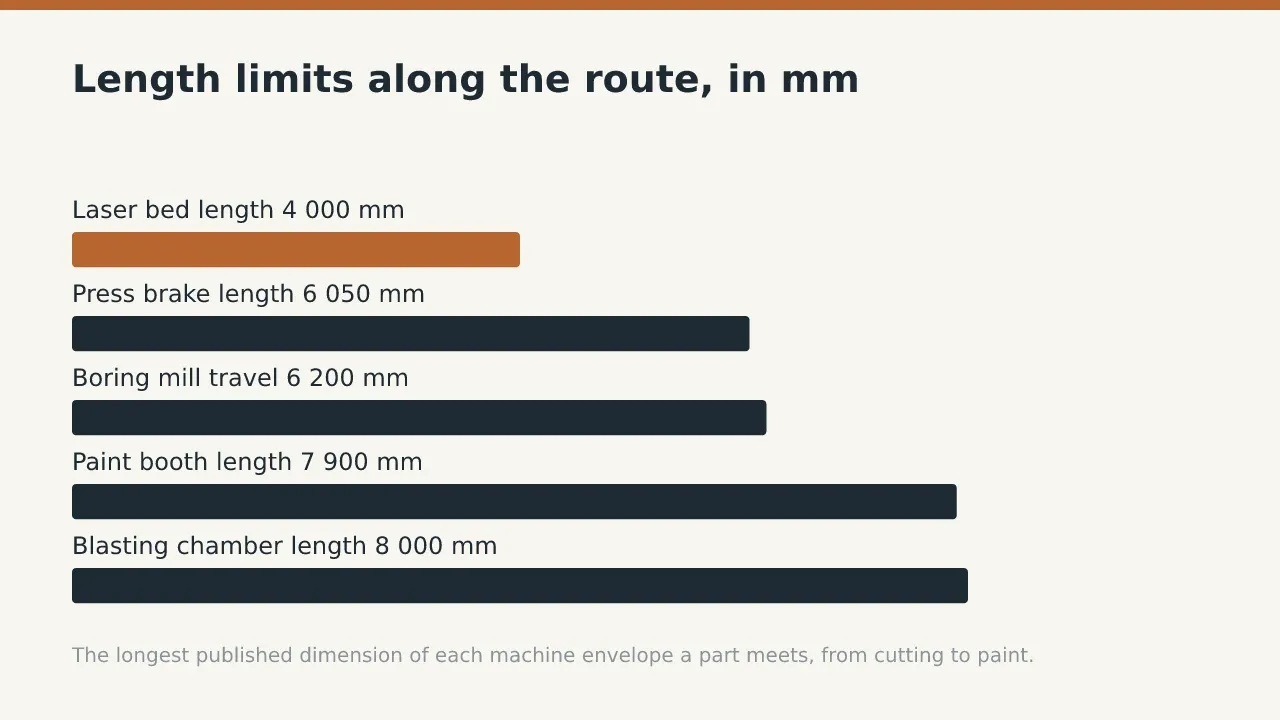
Each machine on the route publishes its envelope. If every dimension of your part sits inside the figures below, the part follows the route as drawn.
| Step | Envelope | What it decides |
|---|---|---|
| Laser cutting | 2 000 x 4 000 mm bed, 20 mm plate | The largest single blank |
| Bending | 400 t over 6 050 mm | The longest single fold |
| Machining | 6 200 x 3 000 x 1 600 mm travel | The largest frame machined after welding |
| Machining, long frames | 8 000 x 3 000 x 1 500 mm travel | Frames longer than 6 200 mm |
| Blasting | 8 000 x 5 000 x 3 000 mm | The largest part blasted whole |
| Painting | 7 900 x 5 000 x 4 890 mm | The largest part painted whole |
Plate between 20 mm and 40 mm is weldable here but over the laser cutting thickness limit. Ask how such plate is cut. A folded member longer than 6 050 mm cannot be bent as a single part, so the drawing must show a joint.
The paint booth, at 7 900 mm, is shorter than the blasting chamber at 8 000 mm. A frame that fits the chamber can still miss the booth, so measure its finished length against 7 900 mm. The chamber is also lower than the booth, at 3 000 mm against 4 890 mm. A tall frame meets the chamber height first. For frames near either limit, read paint booth size for large weldments before you fix the length.
The route your part takes through the hall
Choose your hold point from this route before you order. The measurement before machining is the natural choice, because a frame corrected there loses no machined face.
- Cut the blanks on the TRUMPF laser from plate up to 20 mm, inside its 2 000 x 4 000 mm bed.
- Fold the long members on the DURMA press brake, which presses 400 t over 6 050 mm.
- Weld the fitted frame to a procedure inside the EN ISO 3834-2 scope for its material group.
- Measure the welded frame against the drawing with the FARO measuring arm.
- Machine the bores and faces on a horizontal boring mill once the frame is square.
- Blast the frame to bare steel in the 8 000 x 5 000 x 3 000 mm chamber.
- Paint the frame in the Polin booth, then cure the coat at 75 to 80 °C.
Ask for the report from the measuring step, your record of dimensional inspection before paint against your own drawing. Bores that must line up across the frame are machined once the welding is done, as set out under machining after welding. If your drawing names a paint system, check its data sheet against 75 to 80 °C.
Ask for what the hall does not publish
Some limits are not published, so ask for them in writing before the first order. Crane capacity comes first, because it decides the heaviest frame that can be lifted and turned. The size of the hall and the largest weldment it can take are not published either.
Transport to Germany or Austria is a separate question. Ask who books the truck, and agree who signs the delivery note at your site. Ask as well which language the notes on your drawing should use.
The gallery holds 191 models, each built or quoted here. Look through structures built to a customer drawing for a model close to your part. Such a model shows a size class, not a limit.
Send the drawing once the weld note is filled in
Send the drawing once the material grade and the weld note are on it. Mark the thickest welded plate and the longest folded member. Add the finished weight, because the larger boring mill table carries 16 000 kg and the smaller 12 000 kg. That weight decides which mill takes the frame. The rest of the title block follows what a drawing needs for a quotation.
Then send the drawing as a PDF with its model file. Put your questions on crane capacity and transport in the same message.
FAQ
Does the welding scope cover S355 plate?
Yes. S235 and S355 are ISO/TR 15608 group 1, which the EN ISO 3834-2 scope covers up to 40 mm.
Can austenitic stainless steel be welded as well?
It is ISO/TR 15608 group 8, covered from 3 to 16 mm. Sheet thinner than 3 mm or plate over 16 mm needs a question first.
What length decides whether a frame can be blasted and painted whole?
The paint booth is 7 900 mm long and the blasting chamber 8 000 mm. Check the finished length against 7 900 mm.
What if the drawing names no weld quality level?
Ask the designer before you send it. A frame drawn to EXC2 to EN 1090-2 generally calls EN ISO 5817 quality level C.
Send the drawing with its material and weld note through the quotation request.