
· 5 min read
Laser cutting plate thickness: 20 mm, 40 mm or 3 to 16 mm by grade
The TruLaser 3040 cuts plate up to 20 mm on a 2 000 x 4 000 mm bed. Past that, grade and thickness decide the cutting route, and the welding scope sets the outer limit.
The TruLaser 3040 cuts steel plate up to 20 mm thick on a bed of 2 000 x 4 000 mm. Every part on your drawing inside both limits is cut from a nest, with no separate setup. Plate past either limit takes a different route before it reaches the welder. Grade and thickness on the parts list decide that route at quotation, before the steel arrives.
Which parts go on the laser
Plate up to 20 mm thick that fits the 2 000 x 4 000 mm bed goes on the laser. That is where gussets, brackets, flanges and base plates usually start. Each nest is cut as one program, so parts of the same grade and thickness share a sheet and a price line. The 4 000 mm bed length sets the longest single part the laser can cut. A strip drawn longer than that is cut in pieces and joined by a weld. Place that joint where your design allows it, and mark it on the drawing. The post on laser cutting steel plate to 20 mm follows a sheet through the nest in more detail.
What happens to structural plate between 20 mm and 40 mm
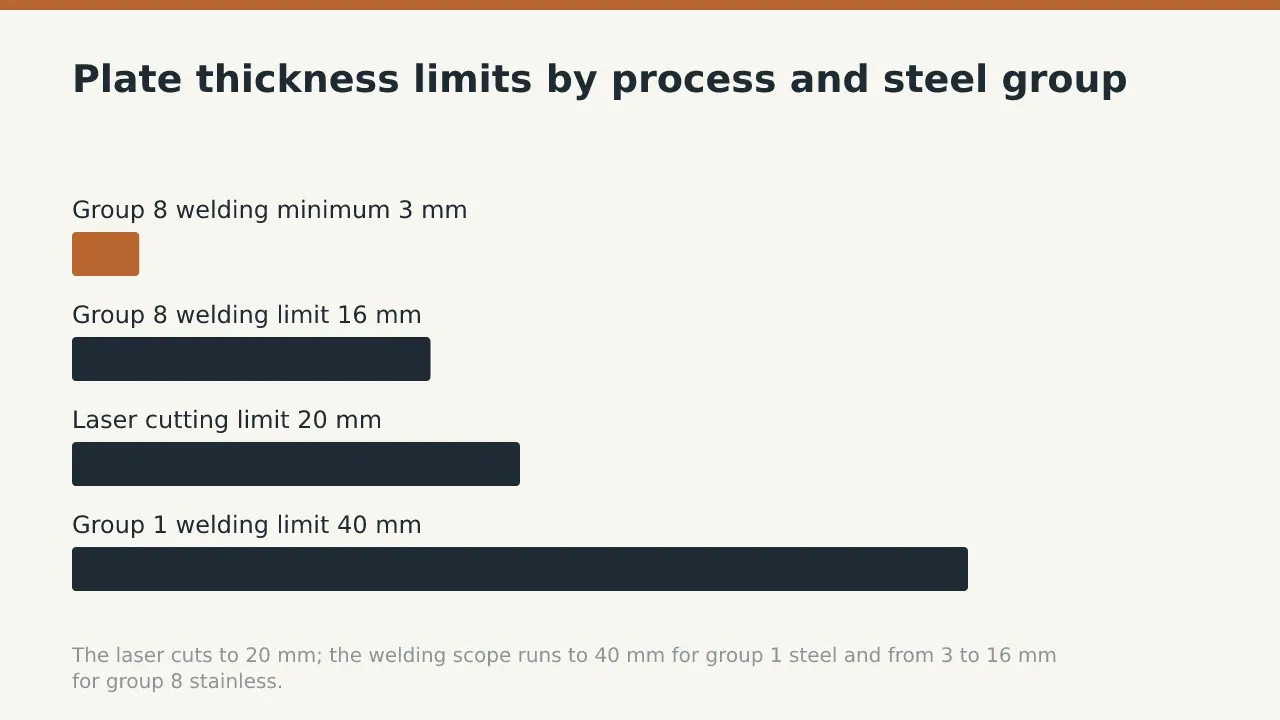
Structural plate between 20 mm and 40 mm leaves the laser and is cut by a different method. It still returns to the same hall for welding, because the EN ISO 3834-2 scope covers ISO/TR 15608 group 1 up to 40 mm. S235 and S355 both sit in group 1. A 40 mm base plate under a machine frame is therefore welded here, even though the laser never touches it. What changes for you is the quotation. The thick part carries its own cutting operation and its own price line. Above 40 mm, group 1 steel falls outside the welding scope. That drawing comes back with a question before it gets a price. If the grade is still open, choosing between S235 and S355 explains what the letters after the number change.
Where stainless stops
For austenitic stainless, the welding scope sets the limit before the laser does. ISO/TR 15608 group 8 is welded from 3 to 16 mm, and that range ends below the laser's 20 mm. A stainless flange drawn thicker than 16 mm is outside the scope. So is a stainless sheet thinner than 3 mm. Keep stainless parts between 3 mm and 16 mm and the drawing needs no query on thickness.
The table sets the limits side by side.
| Material | ISO/TR 15608 group | Welded thickness | Against the 20 mm laser limit |
|---|---|---|---|
| S235, S355 | group 1 | up to 40 mm | plate over 20 mm takes another cutting method |
| Austenitic stainless | group 8 | 3 to 16 mm | the welding scope ends first |
How plate moves from the cutting bed to the paint booth
Once the cutting route is fixed, every plate follows the same order through the hall. Only the first station changes with thickness.
- Cut plate up to 20 mm on the TruLaser 3040, nested across the 2 000 x 4 000 mm bed, so thin parts of one grade share a sheet.
- Cut group 1 plate over 20 mm, up to 40 mm, by the separate method named in the quotation.
- Fold the bent parts on the DURMA press brake, which presses with 400 t along 6 050 mm, so a long edge needs no joint.
- Fit the cut and folded parts in the jig, and tack them once the fitter has the frame square.
- Weld the joints on the robot station, which travels a 14 m track, so a long frame is welded without being moved.
- Blast the weldment in the 8 000 x 5 000 x 3 000 mm chamber, which cleans cut edges and seams before paint.
- Paint the frame and cure the coat at 75 to 80 °C in the Polin AC booth, so it is hard before the crane lifts it.
A welder takes the joints the robot cannot reach. Long folded parts have their own limits, set out in press brake bending of long steel parts.
What to write on the drawing
Write the grade and the thickness against every part in the parts list. Those entries decide the cutting route before anyone prices the job. A blank thickness, or a grade left as plain steel, sends the drawing back with a query. Mark the weld preparation on any plate over 20 mm, because a thick joint needs its edges prepared before welding. Where a thick base plate meets thin gussets, plan the weld sequence with distortion control in welded frames in mind. The checklist in what a drawing needs for a quote covers the rest of the title block. The machines sit on the cutting and forming capacity page, and the joint scope sits on the welding scope by steel group page.
Send the drawing with every grade and thickness filled in. The quotation that comes back names the cutting route for each plate, so you see where 20 mm and 40 mm fall before you order.
FAQ
What is the thickest plate you cut on the laser?
The TruLaser 3040 cuts plate up to 20 mm thick on a 2 000 x 4 000 mm bed. Thicker plate is cut by a different method before welding.
Can you weld S355 plate thicker than 20 mm?
Yes. The EN ISO 3834-2 scope covers ISO/TR 15608 group 1, which includes S235 and S355, up to 40 mm.
What stainless thickness can you weld?
Austenitic stainless, ISO/TR 15608 group 8, is welded from 3 to 16 mm. A stainless part outside that range is raised with you before the order.
What is the largest single part the laser can cut?
The part must fit the 2 000 x 4 000 mm bed. A longer part is cut in pieces and joined by a weld.
Send your drawing and parts list through the quotation page, and the reply will name the cutting route for each plate.