
· 6 min read
Bending long steel parts on one press brake: 400 t over 6 050 mm
A long channel or cover is folded on one DURMA press brake: 400 t of force over 6 050 mm, with 365 mm of stroke. What the operator checks between bends, and what your drawing must show.
Length: one fold up to 6 050 mm
The DURMA press brake in the hall folds steel up to 6 050 mm long in a single stroke. A channel or cover within that length leaves the brake as one piece, with no joint to weld and no seam to grind. Measure the longest fold line on your drawing, not the overall length of the part. That line is the one the brake has to hold.
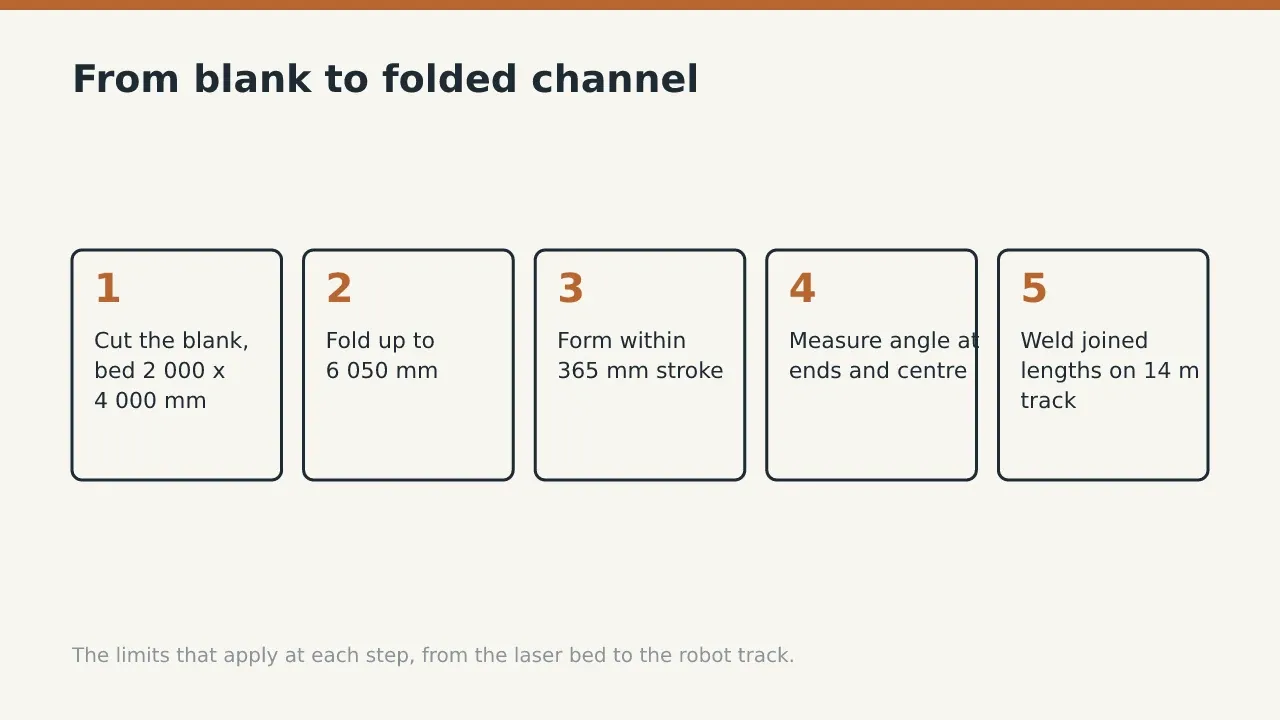
The blank comes first. The TRUMPF laser has a bed of 2 000 x 4 000 mm. A blank that fits the longer side of that bed is cut in one piece, with its holes and slots already in place. A fold longer than the laser bed needs its blank prepared another way, so ask which route the blank takes when you request a price.
| Machine | Limit | What it decides for your part |
|---|---|---|
| TRUMPF laser, bed | 2 000 x 4 000 mm | The largest flat blank cut in one piece |
| TRUMPF laser, thickness | 20 mm | The thickest plate the laser cuts |
| DURMA brake, length | 6 050 mm | The longest single fold line |
| DURMA brake, force | 400 t | The force shared along the whole bend |
| DURMA brake, stroke | 365 mm | The room to form a channel and lift it out |
| Robotic welding station, track | 14 m | The longest joined channel welded in one setup |
Force: what 400 t means on a long bend
The brake presses with up to 400 t. That force is shared along the whole bend line, so a long fold in thick plate uses it up faster than a short one. Thickness, bend length, die opening and grade all raise the force a bend needs.
S355 needs more force than S235 at the same thickness. It also springs back further after the punch lifts, so the operator folds it past the drawn angle. The difference between the two grades goes beyond the brake, and choosing between S235 and S355 covers what the letters after them mean.
The laser cuts plate up to 20 mm. That does not mean every blank of that thickness folds over the full brake length. Whether a given thickness folds over a given length is a calculation made from your drawing. It is not a single figure on a data sheet.
Stroke: 365 mm and the depth of a channel
The upper beam travels 365 mm. That travel sets the room between punch and die, and so the shape of channel that can be formed and lifted out.
A shallow cover with short flanges clears easily. A narrow channel with tall return flanges is the shape to check first. After the last bend, the part must come off the punch without striking it. If the profile is tight, the fold sequence changes, or the section is split into two folded parts welded together.
Show the flange heights and the inside width as dimensions, not only as a sketch. The fold sequence can then be planned before the steel is cut.
How a long channel is folded on the brake
A long channel passes through the same hands in the same order each time.
- Cut the blank on the TRUMPF laser, within its 2 000 x 4 000 mm bed. Holes near a fold line are cut now, so they must sit far enough from the fold to keep their shape.
- Load the blank against the back gauge. The operator squares it along its full length before the first stroke. A blank that sits skew gives a flange that tapers from end to end.
- Fold the first flange. The punch presses the blank into the die within the 365 mm stroke of the beam.
- Measure the angle at both ends and at the centre. Under load a long beam deflects, so the centre can open while the ends are correct. The operator corrects the setting before the next bend.
- Turn the part and fold the second flange. On a narrow channel, the operator watches that the first flange clears the punch.
- Check the flange widths and the straightness along the full length against the drawing. Only then does the channel move on to welding or to the measuring arm.
Laser cutting and press brake bending lists both machines with their working limits in one place. After forming, the measuring arm records the part against the drawing, and inspection of folded and welded parts describes what that check reports.
Parts longer than the brake
A part longer than 6 050 mm is folded in lengths and joined by welding. Decide on the drawing where those joints fall, before the steel is cut.
The conveyor structures in the gallery run from 1.5 to 14.6 m. A long side channel on a conveyor can therefore exceed one fold. The dual robotic welding station has 14 m of track. A channel joined from folded lengths up to 14 m lies on the track in one setup, so every joint is welded to the same program. Where the joints go is a design choice, and robotic welding of long steel parts shows the station that makes them.
Heat from those joints pulls a thin channel out of line. The joint position and weld sequence that keep it straight are covered in distortion control in a welded frame.
What to send with the drawing
A long folded part is quoted from the drawing, so the drawing carries the fold data. Give the grade, the thickness, the inside bend radius, the flange heights and the tolerance on angle and straightness.
A drawing that leaves these open is quoted on assumptions, and what a drawing needs for a quotation lists the other items to include. The route the part takes after the brake, through welding, blasting and paint, is set out in the steps from drawing to delivered weldment.
Mark the longest fold line on the drawing and check it against 6 050 mm. If it is longer, show where a joint may go. Then send the drawing with the grade and the quantity.
FAQ
How long a part can the press brake fold in one piece?
Up to 6 050 mm along the fold line. A longer part is folded in lengths and joined by welding.
What thickness can be folded over the full length?
It depends on grade, die opening and bend length, which all share the 400 t of force. It is calculated from your drawing, not read from one figure.
Can a narrow channel with tall flanges be formed?
The beam travels 365 mm, which limits how tall the flanges on a narrow channel can be before the part no longer clears the punch. Send the profile dimensions and the fold sequence is checked before the quotation.
How large a blank can the laser cut?
The laser bed is 2 000 x 4 000 mm, and it cuts plate up to 20 mm thick.
Send your drawing through the request a quotation for a folded part page, and the longest fold is checked against the brake before a price is given.