
· 6 min read
Laser cutting steel plate: what 2 000 x 4 000 mm and 20 mm decide
A part whose flat outline fits 2 000 x 4 000 mm, in plate up to 20 mm, comes off the TruLaser 3040 in one piece. Longer parts are split in the nest and welded back at a joint the drawing allows.
A sheet of S355 arrives at the laser 20 mm thick. The programmer checks two limits before the plate is cut. The TRUMPF TruLaser 3040 has a bed of 2 000 x 4 000 mm and cuts steel up to 20 mm. A part that fits inside both comes off the machine in one piece. A part that does not is split, welded back and inspected. That joint then appears in your price and on your drawing.
Does your part fit on the bed in one piece?
It fits if its flat outline stays inside 2 000 x 4 000 mm. That bed sets the largest single profile the laser can cut, so it also sets where a long member needs a joint.
For a folded part, the flat outline counts, not the finished shape. A channel is wider flat than it is on the drawing, because both flanges lie open on the bed. Check the developed width and length against the bed before you fix the section. The flat pattern is one of the items listed in what a drawing needs before we quote, and it saves a round of questions at quotation.
How thick can a laser cut steel part be?
The TruLaser 3040 cuts steel plate up to 20 mm at 3 200 W of laser power. A base plate or gusset drawn thicker leaves the laser route, which changes how it is cut and priced.
The welders reach further than the laser. Welding covers ISO/TR 15608 group 1, the unalloyed and fine grain structural steels, up to 40 mm. S235 and S355 are both group 1, so any laser cut edge in those grades sits inside the welding scope. Austenitic stainless steel, ISO/TR 15608 group 8, is welded from 3 to 16 mm. Which grade your frame needs is explained in S235 or S355 for a welded frame.
| Limit | Value | What it changes for you |
|---|---|---|
| Laser bed, TRUMPF TruLaser 3040 | 2 000 x 4 000 mm | Largest flat outline cut in one piece |
| Laser cutting thickness | 20 mm | Thicker plate leaves the laser route |
| Laser power | 3 200 W | The source behind the 20 mm limit |
| Press brake length | 6 050 mm | Longest fold after the part is cut |
| Press brake force | 400 t | Force available for thick or long folds |
| Welding, group 1 steels | up to 40 mm | Every laser cut plate in S235 or S355 can be welded |
What happens to the plate on the laser
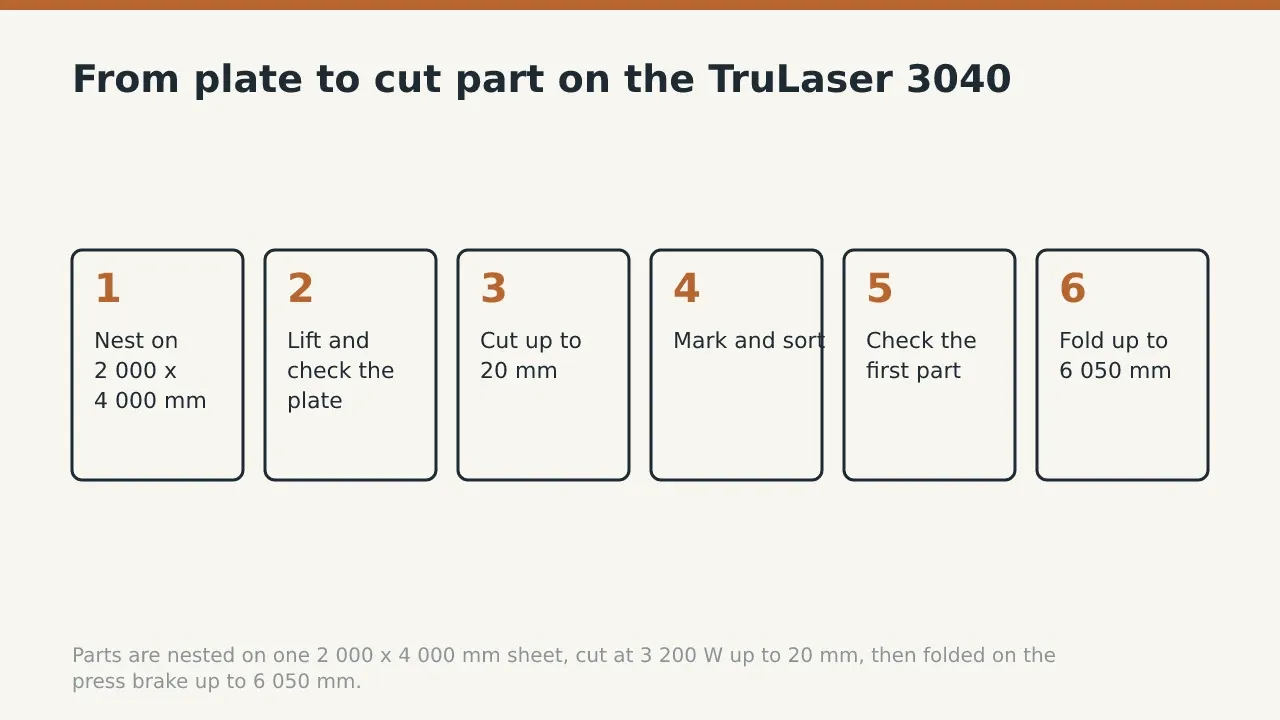
The plate is nested, cut, marked and checked before any part is folded or welded. Each step fixes something that would cost more to correct later in the hall.
- Nest the profiles. The programmer lays every part of the order across one 2 000 x 4 000 mm sheet. Large parts go first, and small brackets fill the gaps.
- Lift the plate onto the cutting pallet. The crane driver sets the sheet down, and the operator checks grade and thickness against the cutting order.
- Cut the nest. The 3 200 W beam cuts holes and slots before outer contours, so each part stays in place until it is free.
- Mark and sort the parts. The operator breaks them out of the skeleton and marks each with its part number and heat number.
- Check the first part. The inspector measures the first profile of each nest against the drawing before the rest move on.
- Fold the bent parts. Profiles with bend lines go to the press brake, which folds up to 6 050 mm at 400 t.
The heat number marked on each part lets you trace a plate from the mill to the weldment through every later step. Long folds have their own limits, set out in bending long parts on one press brake.
When is a long part split and welded back?
A part is split when its flat outline is longer than the bed. The pieces are cut in the same nest, from the same plate, and welded back at a joint the drawing allows.
The machine frames in the gallery run from 1.5 to 13.6 m. A frame at the upper end of that range is built from many cut and folded parts. Its joints are planned on paper, not found in the hall. Weld heat moves a long member, and the position of each joint is part of designing a frame for distortion control. The joint is then inspected like any other seam, to the quality level your seams are held to.
Where must a joint never go?
A joint must not sit on a bearing seat, a bolted face or a machined surface. Mark those zones on the drawing, and the programmer places the split elsewhere.
Where the frame is machined after welding, its datum faces are cut last. The boring mill has 6 200 x 3 000 x 1 600 mm of travel. Faces inside that envelope are cut after the weld has moved the member, so they end up true. The sequence and its limits are set out in machining a frame after it is welded. The limits for each step sit on the pages for cutting and forming capacity and welding capacity. Frames built this way are shown on the page for welded machine frames.
Send the drawing with the flat outline, grade and thickness of each plate part, and mark every zone where a joint must not sit. The quotation then shows which parts come off the laser whole and where each joint goes.
FAQ
What is the largest plate part you can laser cut in one piece?
A flat outline up to 2 000 x 4 000 mm, in steel up to 20 mm thick, cut on the TRUMPF TruLaser 3040.
What happens if my part is longer than the laser bed?
It is cut in pieces from the same nest and welded back at a joint the drawing allows. Mark any zone where a joint must not sit.
Which grades can be welded after cutting?
S235 and S355, ISO/TR 15608 group 1, up to 40 mm, and austenitic stainless steel, ISO/TR 15608 group 8, from 3 to 16 mm.
How long can a folded part be?
The press brake folds up to 6 050 mm at 400 t. A single laser profile is still limited to the 2 000 x 4 000 mm bed.
Send your drawing through the quotation page and mark any part that must stay in one piece.