
· 6 min read
Paint and machined faces: mask before blasting or machine after cure
A machined bearing seat and a blasted frame need opposite surfaces. The travel of the boring mill and the curing temperature decide whether the faces are masked or machined last.
A welded frame with machined bearing seats reaches the blasting chamber carrying surfaces that want opposite treatment. The structural steel needs a clean, rough profile so the paint holds. The bearing seat needs the face the cutter left, to the tolerance on the drawing. The finishing sequence decides which surface wins.
Mask or machine after cure: which route fits your frame
Machine after cure when the faces are few, open to the spindle and inside the travel of the boring mill. Mask before blasting when the faces are many and scattered, or when the frame must leave the paint booth with no bare steel on it. The choice also moves the inspection. On the masked route the inspector measures bare steel before any coating goes on. The post on dimensional inspection before paint shows how a frame is checked against the drawing at that stage. On the machined route the last measurement happens on the mill table, after the last cut.
Leave stock or protect the face: what the blast and the cure demand
A machined face cannot meet the blast bare. It either carries stock that the cutter removes later, or a mask that survives both the abrasive and the cure. Blasting at full pressure pits a bearing seat, cuts through tape and packs grit into a thread.
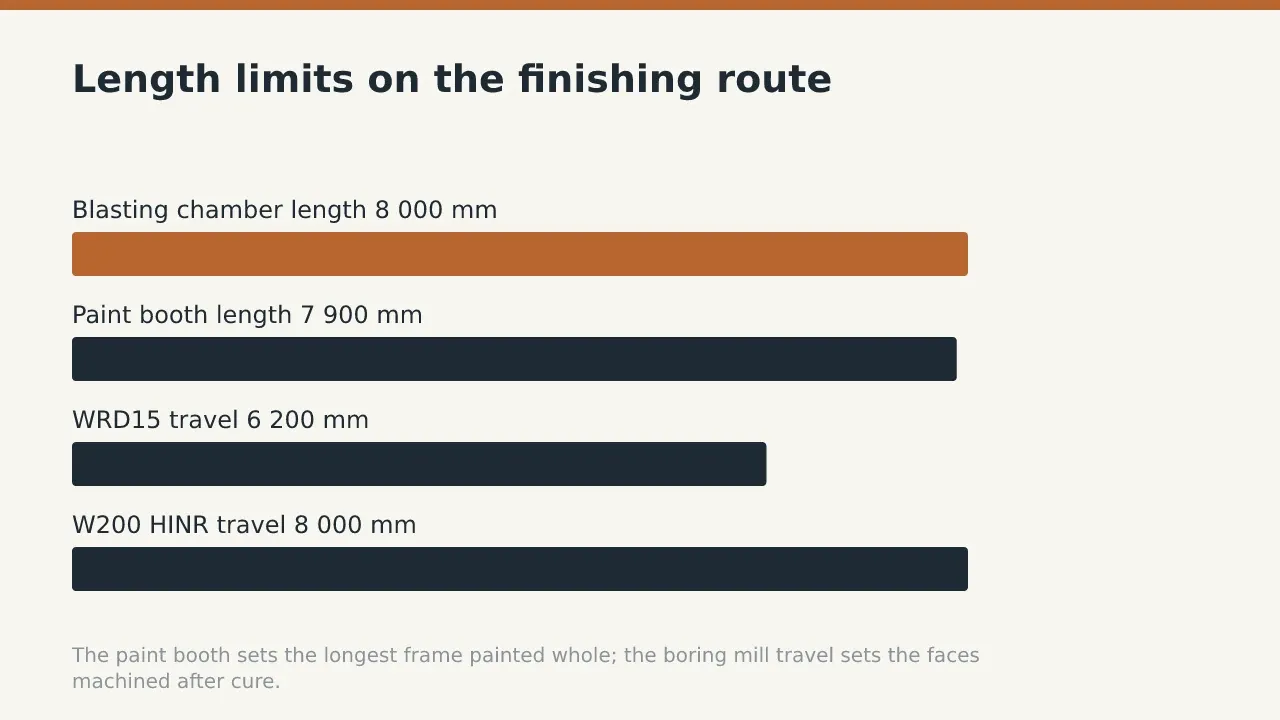
The compressed air blasting chamber measures 8 000 x 5 000 x 3 000 mm. A frame up to 8 000 mm long goes in whole, so the operator blasts every face in one pass. The 3 000 mm height is the lower ceiling on the route, so a frame taller than that is blasted lying on its side.
The Polin AC spray and curing booth measures 7 900 x 5 000 x 4 890 mm. Its 7 900 mm length, not the chamber, sets the longest frame painted in one piece. The comparison of paint booth size for large weldments sets the two rooms side by side. The coating cures at 75 to 80 °C. Any mask that stays on through the booth must hold at that temperature without lifting or leaving residue on the face.
The finishing sequence when the faces are machined last
On this route the faces leave the welding bay with stock still on them. The blast pits that stock, and the cutter removes it after the paint cures.
- Weld the frame and let it cool to the temperature of the hall.
- Measure it with the measuring arm and record the stock left on each face to be machined.
- Blast the whole frame in the 8 000 x 5 000 x 3 000 mm chamber, stock and all.
- Paint it in the 7 900 x 5 000 x 4 890 mm booth while the blasted surface is still clean.
- Cure the coating at 75 to 80 °C, then let the frame cool before the crane lifts it.
- Lift it onto the boring mill table on padded slings, and clamp it through soft pads that leave the paint unmarked.
- Machine the bores and faces, then coat the bare metal with the preservative the drawing names.
On the masked route, machining moves ahead of the blast. The fitter plugs each bore and caps each face before the frame enters the chamber. The steps inside the chamber are described in blasting welded steel before painting.
When the frame fits the WRD15: machine after cure
Machine after cure when every machined face sits inside the 6 200 x 3 000 x 1 600 mm travel of the TOS Varnsdorf WRD15. Faces that lie within 6 200 mm of each other along the frame are cut in one setup, so their positions share one reference. The table measures 1 800 x 2 500 mm and carries 16 000 kg, which sets the heaviest painted frame it takes. The 160 mm spindle gives the stiffness to bore deep bearing seats through a heavy wall.
A frame under 12 000 kg, with its faces inside 3 500 mm, can go on the TOS Varnsdorf WHQ13 instead. The post on boring mill table load compares the two machines. Longer frames move to the W200 HINR horizontal boring mill, with 8 000 x 3 000 x 1 500 mm of travel. That length matches the blasting chamber, so the 7 900 mm booth stays the limit on length.
| Station | Length | Width | Height | What it decides |
|---|---|---|---|---|
| Blasting chamber | 8 000 mm | 5 000 mm | 3 000 mm | Largest frame blasted whole |
| Polin AC booth | 7 900 mm | 5 000 mm | 4 890 mm | Longest frame painted in one piece |
| TOS Varnsdorf WRD15 travel | 6 200 mm | 3 000 mm | 1 600 mm | Faces machined after cure in one setup |
| W200 HINR travel | 8 000 mm | 3 000 mm | 1 500 mm | Faces on frames past 6 200 mm |
The setup and the cutting are followed in machining welded frames on a horizontal boring mill. Spindle, travel and table figures for each mill sit on the machining capability page.
When masking is the better route
Mask before blasting when the frame carries many machined features spread over its whole length. Each bore takes a plug and each face a cap, and the frame then runs through blast, paint and cure without returning to the mill. The faces are machined first, on bare steel, while the frame is easy to clamp and measure. The masks must then survive the abrasive and 75 to 80 °C in the booth. After cure the fitter removes them and cleans each face. A face where grit got under a cap goes back to the mill, and the paint around it is repaired by hand. Both routes run through the same surface treatment of welded steel line, so the choice changes the order, not the equipment.
What to mark on the drawing
Mark each machined face on the drawing with its tolerance. State whether it may carry paint, preservative or nothing. With that, the sequence is fixed at quotation instead of on the shop floor. The checklist in what a drawing needs for a quotation covers the other notes a welded machine frame drawing should carry.
FAQ
Can a machined face go through the blasting chamber unprotected?
Only if it still carries machining stock. The cutter removes the blasted layer after the paint cures at 75 to 80 °C.
How long can a frame be and still be machined after painting?
The TOS Varnsdorf WRD15 has 6 200 mm of travel along the frame, and the W200 HINR has 8 000 mm. The paint booth, at 7 900 mm long, then sets the limit.
How heavy can a painted frame be on the boring mill table?
The WRD15 table measures 1 800 x 2 500 mm and carries 16 000 kg. The WHQ13 table carries 12 000 kg.
Does masking survive paint curing?
Each plug and cap has to hold at 75 to 80 °C in the curing booth, so the masks are chosen for that temperature. They come off after the frame has cooled.
What protects a face machined after paint?
The preservative or coating named on the drawing, applied after the last cut. If the drawing names none, ask for one at quotation.
Send the drawing with each machined face and its tolerance marked, and request a quotation for the frame.