
· 7 min read
Belt conveyor frames: 6 050 mm of press brake, 7 900 mm of paint booth
A belt conveyor frame meets the hall at three lengths: the 6 050 mm press brake, the 14 m robot track and the 7 900 mm paint booth. What the drawing must show, and where those lengths place the joints.
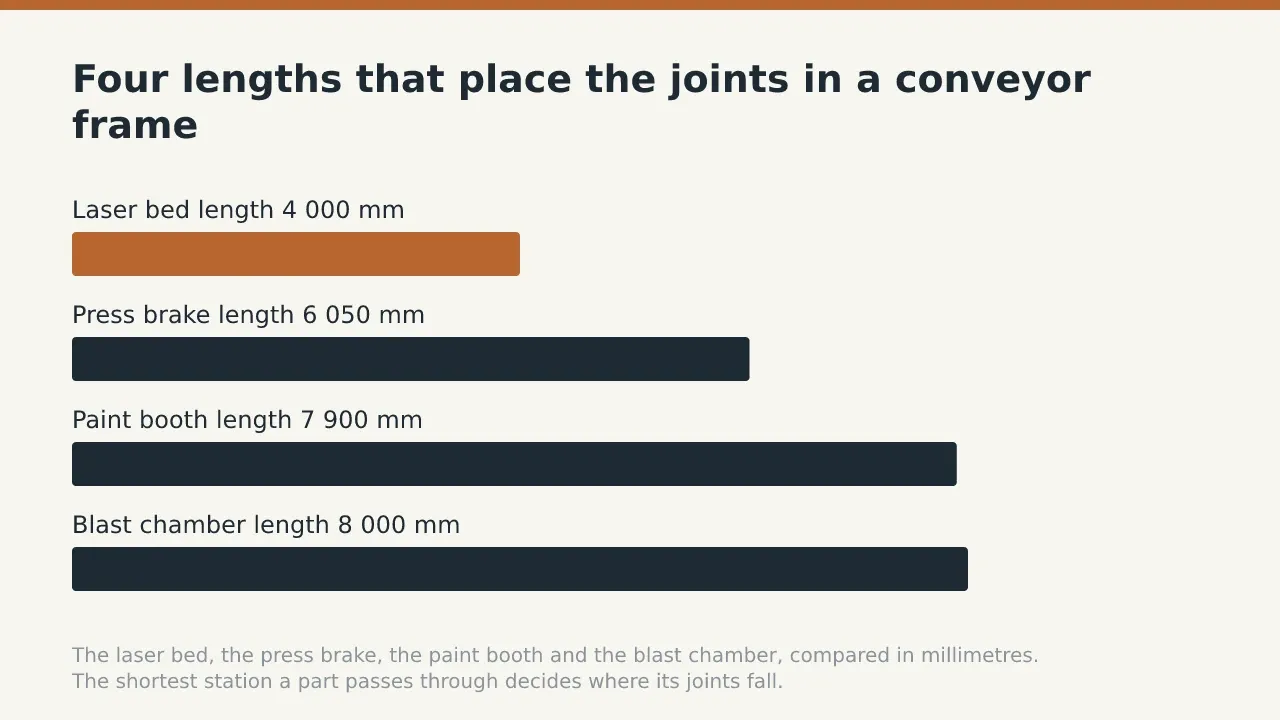
Every side wall of a belt conveyor frame folds on one press brake, in lengths up to 6 050 mm. That length decides where the joints in a long trough fall. The joints decide how straight the idler line stays and how the frame goes through blast and paint. The catalogue files these frames under conveyor structures to drawing, next to supports, mobile plant and other handling steel.
Which structures count as belt conveyor frames
A belt conveyor frame carries the belt, the idlers and the drive drum, either on a plated trough or on a welded truss. The catalogue shows 12 published belt conveyor frames among 25 conveyor and handling structures. The conveyor and handling structures run from 1.5 to 14.6 m in their longest dimension. Each was built or quoted here, and none of them marks a size limit.
A plated trough uses folded side walls, stiffeners and cross bracing. A truss uses twin chords and diagonals. Both carry idler brackets that must sit on one line from end to end.
This belt conveyor frame with drive measures about 11.2 m long, 1.6 m wide and 1.5 m high. It has plated side walls, a folded edge rail, evenly spaced stiffeners and sloped legs under the drive.
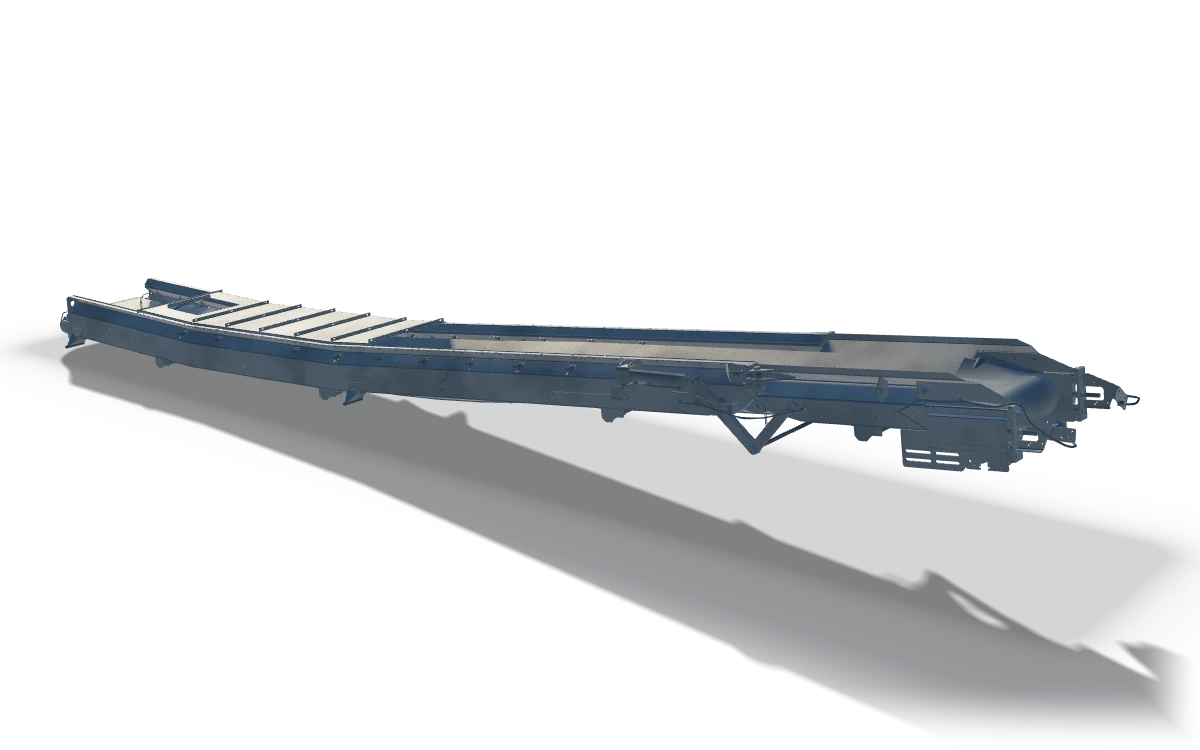
Parts like this are tacked up on a fixture and welded through. Their plate is laser cut up to 20 mm and folded over 6 050 mm on the press brake. At 11.2 m, the frame is longer than one folded wall, so the drawing has to place the wall joints.
The discharge conveyor frame below is a welded truss, about 10.2 m long, 1.1 m wide and 1.7 m high. It has twin top and bottom chords, zigzag diagonals and end plates with mounting bores.
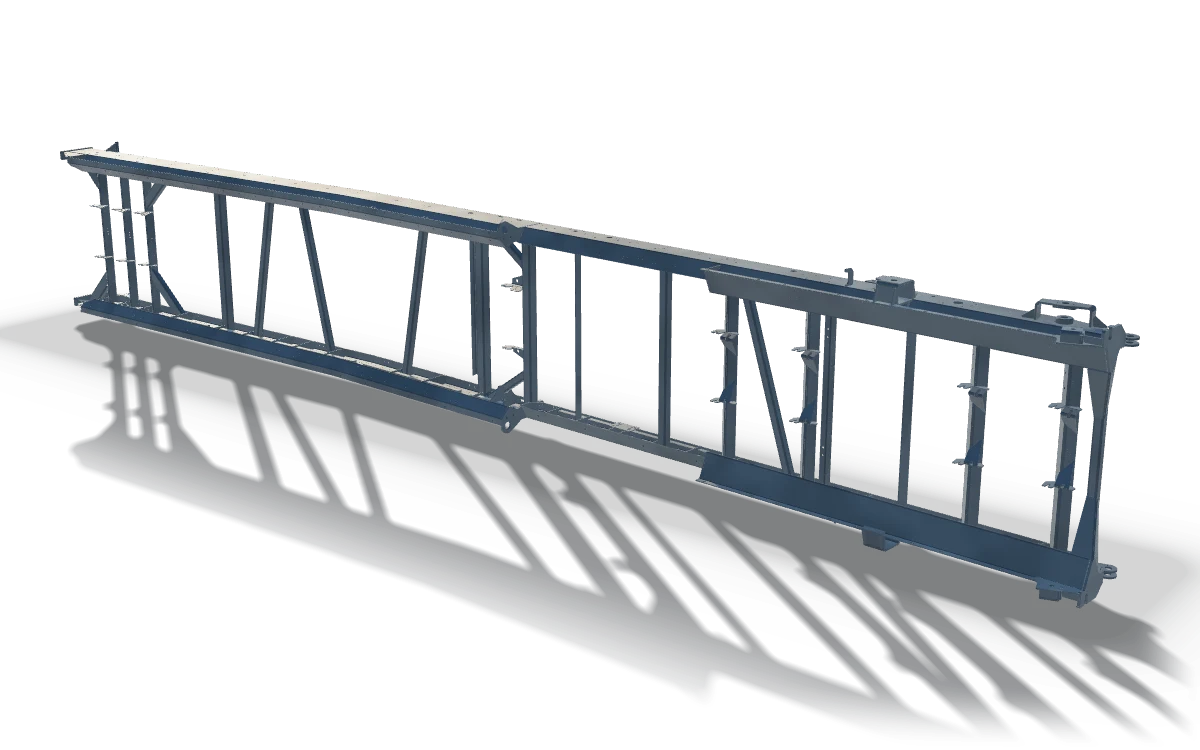
Such parts are welded on the robotic track or by hand. The bores and pads are machined after welding, so they line up with the frame as welded.
What the drawing must show before it is priced
The drawing must show the steel grade, every plate thickness and every weld. Without those three, the hours in a quote are a guess. A guide to what a drawing needs for a quote covers the general rules, and a conveyor frame adds four of its own:
- the idler bracket positions and the tolerance on their line
- the faces and bores machined after welding
- the position of any bolted splice
- the paint system and its colour
S235 and S355 are ISO/TR 15608 group 1, welded here up to 40 mm. Either grade therefore stays inside the welding scope at that thickness, and choosing between S235 and S355 becomes a question of strength. A washdown frame in austenitic stainless steel is ISO/TR 15608 group 8, welded here from 3 to 16 mm. Stainless plate thicker than 16 mm falls outside that scope, so the drawing should keep stainless walls inside it.
Where frame length and plate thickness set the work
Length sets the joints and thickness sets the cutting route. Both belong on the drawing before the quote.
The laser bed is 2 000 x 4 000 mm, so no laser cut part here is longer than 4 000 mm. Brackets, gussets and end plates fit it, and a long wall with cut openings needs its joints shown. The press brake folds 400 t over 6 050 mm, so a folded wall longer than that needs a welded or bolted joint. Plate above 20 mm is beyond the laser, which matters for drive plates and end plates. The article on where laser cutting stops at 20 mm follows that limit plate by plate.
| Station | Size that matters | What it decides |
|---|---|---|
| Laser cutting | 2 000 x 4 000 mm bed, 20 mm plate | Longest and thickest laser cut part |
| Press brake | 400 t over 6 050 mm | Longest side wall without a joint |
| Robotic welding | 14 m track, R 2 008 mm reach | Longest seam run along the frame |
| Blast chamber | 8 000 x 5 000 x 3 000 mm | Longest piece blasted whole |
| Paint booth | 7 900 x 5 000 x 4 890 mm | Longest piece painted and cured whole |
Long seams pull a frame out of line as they cool. The dual robotic station runs a 14 m track, so the long seams of a frame up to that length run without moving the frame. Weld sequence is the other half, and distortion control on a long welded frame shows how it keeps the idler line straight. The stations themselves are listed under laser cutting and press brake forming and robotic and manual welding.
How a belt conveyor frame moves through the hall
The frame goes from plate to painted weldment in seven steps. Each step checks something the drawing fixed.
- Cut the side walls, cross members, gussets and idler brackets on the TRUMPF laser, from plate up to 20 mm.
- Fold the edge rails and trough walls on the DURMA press brake. A wall up to 6 050 mm folds without a joint.
- Tack the walls, cross members and brackets on a fixture. The fitter checks the idler line and the diagonals before any seam is welded through.
- Weld the long seams on the robotic station along its 14 m track. The welder finishes by hand where a joint lies beyond the R 2 008 mm reach of the arm.
- Machine the end plate bores and drive pads on a horizontal boring mill after welding. The longest mill travels 8 000 x 3 000 x 1 500 mm, which sets the frame or section it takes in one setup.
- Measure the frame against the drawing with the FARO measuring arm before any paint goes on.
- Blast the frame to bare steel in the 8 000 x 5 000 x 3 000 mm chamber. Paint it and cure it at 75 to 80 °C in the Polin booth, so the coating is hard before the crane lifts it.
Measuring before paint matters because a correction after paint means blasting again. Dimensional inspection before paint follows that check, and machining welded frames on a boring mill follows step five.
Where to split a long frame for blast and paint
A frame longer than 7 900 mm does not fit the paint booth in one piece. Split it at a bolted joint on the drawing, or agree the finishing plan before the quote.
The blast chamber is 8 000 mm long, so the booth, not the chamber, sets the limit. The article on booth size for large weldments compares the two in detail. Place the splice away from the drive drum and the idler brackets, where two flanged ends can be bolted square. Both halves then go through blasting and painting whole and meet again at the bolted flange.
Send the drawing with the grade, the plate thicknesses, the idler line tolerance, the machined faces and any splice marked. On a frame longer than 7 900 mm, the splice position is the first question the quote will ask.
FAQ
How long can a conveyor side wall be folded without a joint?
The press brake folds up to 6 050 mm at 400 t. A longer wall needs a joint that the drawing places.
Can a frame longer than the paint booth be painted whole?
The paint booth is 7 900 mm long and the blast chamber 8 000 mm. A longer frame should be split at a bolted joint shown on the drawing.
Which steels can the frame be welded in?
S235 and S355 are ISO/TR 15608 group 1 and are welded up to 40 mm. Austenitic stainless steel is group 8 and is welded from 3 to 16 mm.
Are the end plate bores machined before or after welding?
After welding, on a horizontal boring mill with up to 8 000 x 3 000 x 1 500 mm of travel. The bores then line up with the frame as welded.
How thick can laser cut parts be?
The laser cuts plate up to 20 mm on a 2 000 x 4 000 mm bed. Thicker drive plates and end plates need their cutting route agreed in the quote.
Send your belt conveyor frame drawing through the quote request page with the grade, thicknesses and splice positions marked.