
· 6 min read
8 000 or 7 900 mm long: the finishing bottleneck for big weldments
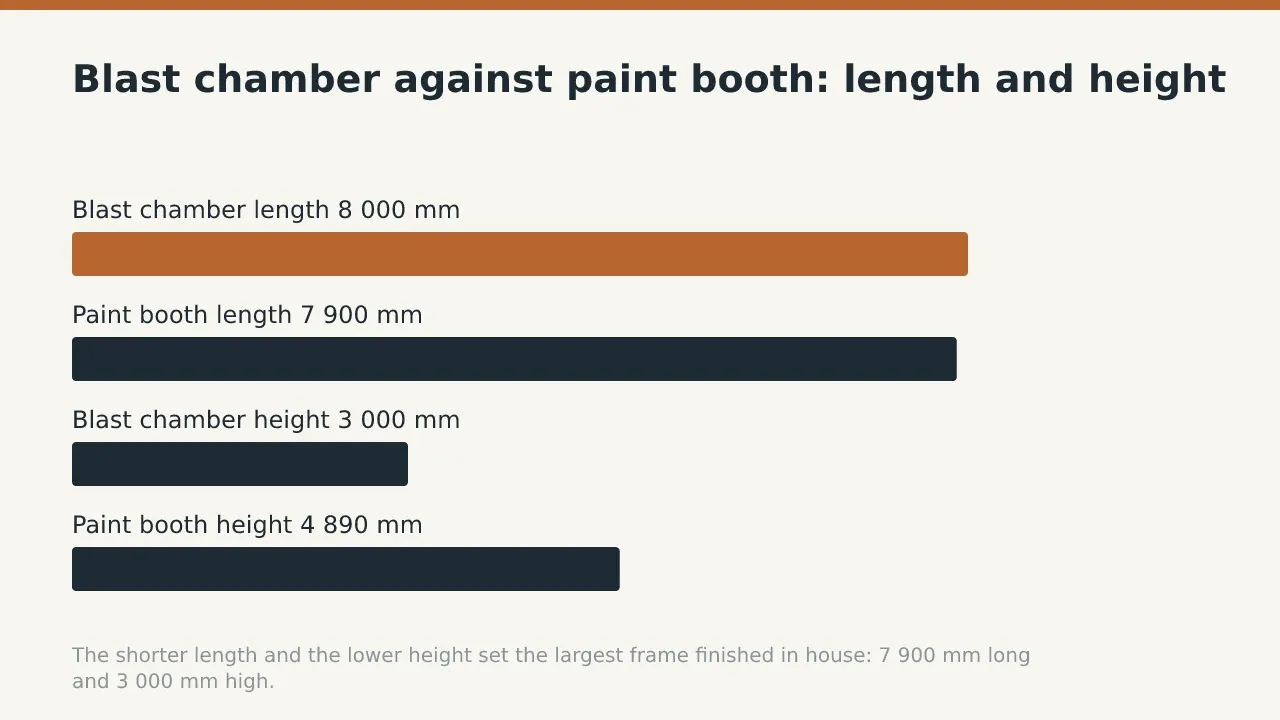
A weldment has to fit both the 8 000 x 5 000 x 3 000 mm blast chamber and the 7 900 x 5 000 x 4 890 mm paint booth. The smaller room on each axis sets the limit.
A welded frame is not finished when the last seam cools. It still has to pass through the blast chamber and then the paint booth. The blast chamber measures 8 000 x 5 000 x 3 000 mm. The paint booth measures 7 900 x 5 000 x 4 890 mm. Your frame has to fit inside both rooms in turn. On each axis the smaller room decides, and that sets the largest part finished in house.
Which room limits your frame on each axis
The limit is 7 900 mm long, 5 000 mm wide and 3 000 mm high. The paint booth sets the length, the blast chamber sets the height, and the width is the same in both.
| Axis | Blast chamber | Paint booth | Limit for your part |
|---|---|---|---|
| Length | 8 000 mm | 7 900 mm | 7 900 mm |
| Width | 5 000 mm | 5 000 mm | 5 000 mm |
| Height | 3 000 mm | 4 890 mm | 3 000 mm |
A frame that clears the blast chamber on length can still be too long for the paint booth. A frame that clears the paint booth on height can still be too tall for the blast chamber. Neither machine alone answers the question.
These are the inside sizes of the rooms, not the size of the part. The blaster and the painter must reach every face. That includes the underside and the inside corners. Leave working space on any axis where your design comes close to the limit. The current figures for both rooms are listed on the surface treatment capabilities page.
Size the frame for the paint booth, not the welding station
Welding is not where a long frame stops. The robotic welding station runs on a 14 m track, so a frame can be welded far longer than the 7 900 mm booth can paint.
Machining sits in the same position. The W200 horizontal boring mill travels 8 000 mm on its long axis. That already exceeds the length of the paint booth. A frame can therefore be welded and machined and still not fit the room that finishes it. Check the finishing size first. It is the smallest limit an assembled frame meets on its way through the hall.
This matters most for long welded machine frames and conveyor sections, where length grows with the line they serve.
Stand the frame upright or lay it on its side
A frame taller than 3 000 mm has to enter the blast chamber lying down. That works only if another axis of the frame stays under 3 000 mm, because that axis becomes the height.
The gallery groups weldments into height classes by structure type, and each class meets the chamber differently. Enclosures and housings sit in the 2.8 m class. That is under the 3 000 mm chamber height, so they can stand upright. Machine frames sit in the 3.4 m class and conveyor structures in the 3.9 m class. Both stand taller than the chamber. A frame of that height goes in on its side, with its height taken along the 5 000 mm width.
Platforms and access steel sit in the 6.0 m class. That is more than the 5 000 mm width of either room. A platform of that size has to lie along the 7 900 mm length.
The paint booth is 4 890 mm high. Frames in the 3.4 m and 3.9 m classes fit under it standing up. Standing them upright again for paint gives the painter a clear reach to every face.
Where the size is checked between blasting and paint
The size is checked at each door, not only on the drawing. The frame moves through the steps below in this order.
- Measure the frame against the drawing with the measuring arm before it leaves the welding bay, so any deviation is corrected on bare steel.
- Lift the frame into the 8 000 x 5 000 x 3 000 mm blast chamber, laid on its side if it stands taller than 3 000 mm.
- Blast every face, the underside and the inside corners included, until the whole surface is clean bare steel.
- Lift the blasted frame into the 7 900 x 5 000 x 4 890 mm paint booth while the surface is still clean.
- Spray the coating, with the frame stood upright again if its height is under 4 890 mm.
- Cure the paint at 75 to 80 °C in the same booth, so the coat is hard before slings touch it.
- Lift the cured frame out for the final check and loading.
The measurement before blasting is covered in full in dimensional inspection before paint. The blasting itself follows the sequence set out in blasting welded steel before painting. A frame cured at 75 to 80 °C stays in the booth for the whole cycle, and how the paint is cured describes that cycle.
Split a frame that is longer than 7 900 mm
A frame longer than 7 900 mm cannot be painted as a single piece in the booth. Split it into sections that each fit 7 900 x 5 000 x 3 000 mm, then bolt them together after paint.
Place the split where a bolted joint can carry the load. Give the joint machined flange faces. Machined faces let the sections line up on site without filling or grinding. Shorter sections also give distortion less length to build up over, a point covered in designing a frame for distortion control. If the drawing does not yet show a split, engineering support can propose one before the frame is priced.
Put the finishing size on the drawing
Write the largest assembled size and the coating on the drawing. The fit against both rooms can then be checked before a price is set.
Mark which axis stands vertical in service. That tells the shop whether the frame enters the 3 000 mm chamber upright or on its side. Add both to the other items in what a drawing needs before a quote, then send the drawing for pricing.
FAQ
What is the largest weldment that can be blasted and painted in house?
The limit is 7 900 mm long, 5 000 mm wide and 3 000 mm high, the smaller of the two rooms on each axis. Leave working space inside that envelope so every face can be reached.
Why is height limited to 3 000 mm when the paint booth is 4 890 mm high?
The frame is blasted before it is painted, and the blast chamber is 3 000 mm high. A taller frame has to enter the chamber lying on its side.
At what temperature is the paint cured?
The paint is cured at 75 to 80 °C inside the 7 900 x 5 000 x 4 890 mm booth, with the frame in the booth for the whole cycle.
What happens to a frame longer than 7 900 mm?
It has to be split into sections that each fit the paint booth, then bolted together after paint. Welding is not the constraint, because the robotic welding station runs on a 14 m track.
Send your drawing with its overall size marked through the quote page, and the fit against both rooms is checked before pricing.