
· 6 min read
Weldment height by structure type: 2.8 m, 3.4 m, 3.9 m or 6.0 m
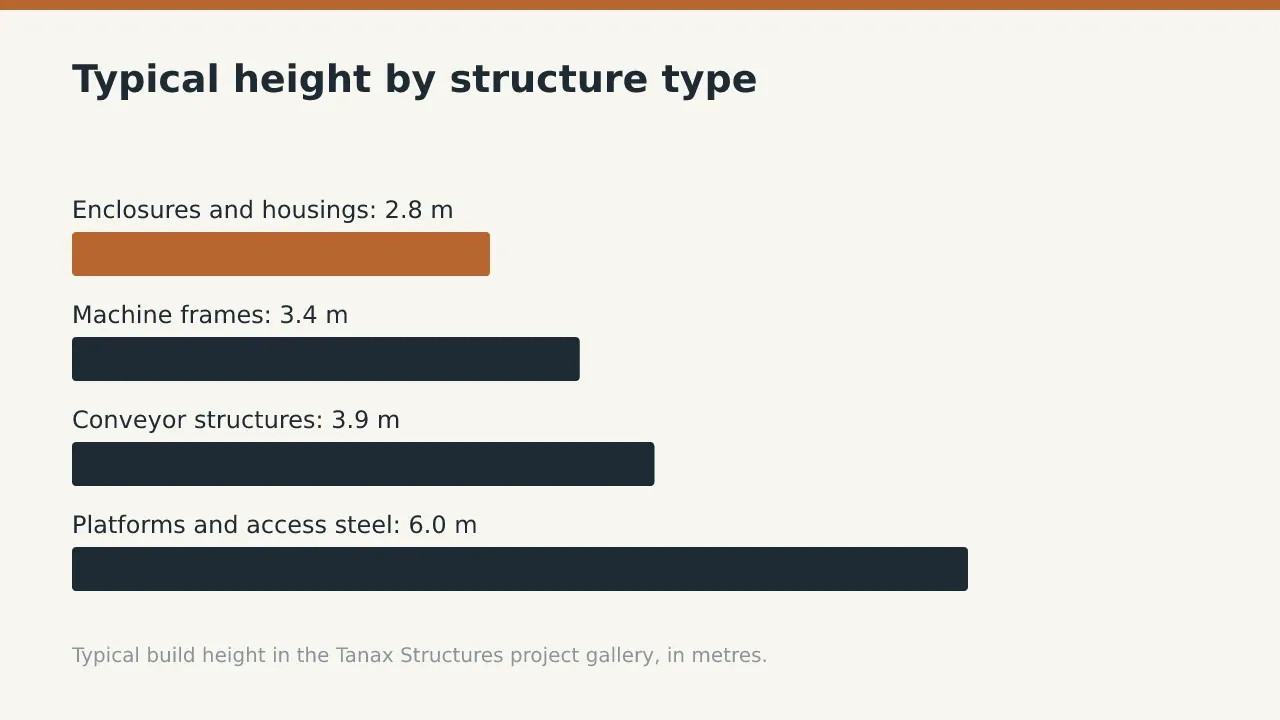
A typical enclosure stands 2.8 m tall and a typical platform stands 6.0 m. The height class of a weldment decides how it is blasted, painted, machined and loaded.
Across the Tanax Structures project gallery, a typical platform stands 6.0 m tall and a typical machine frame stands 3.4 m. That height decides how the part is lifted, blasted, painted and loaded. It is on the drawing before a single plate is cut. A buyer who reads it early gets a quotation that already says how the part will move through the hall.
Which height class your weldment falls into
The structure type sets the height class, and the class sets the handling. Enclosures sit near 2.8 m, machine frames near 3.4 m, conveyor structures near 3.9 m and platforms near 6.0 m.
| Structure type | Typical height | Upright in the blast chamber | Upright in the paint booth |
|---|---|---|---|
| Enclosures and housings | 2.8 m | Yes | Yes |
| Machine frames | 3.4 m | No | Yes |
| Conveyor structures | 3.9 m | No | Yes |
| Platforms and access steel | 6.0 m | No | No |
An enclosure at 2.8 m is the one class that stays upright through blasting and painting, so the crane never has to turn it during surface treatment. A machine frame at 3.4 m or a conveyor structure at 3.9 m is laid down for blasting and stood up again for paint. A platform at 6.0 m is taller than both rooms. Its drawing should show where it splits or which face may lie down.
If the drawing shows welded machine frames for a production line, expect the 3.4 m class. A stair tower or walkway belongs with platforms and access steel, where 6.0 m is typical. Length has its own classes, set out in welded part size by structure type.
Whether the part stands upright in the blast chamber and paint booth
A part stands upright only if it is shorter than the room it enters. Anything taller goes in lying on its side.
The blast chamber measures 8 000 x 5 000 x 3 000 mm, length by width by height. Every class above the enclosure is therefore blasted lying down. Each turn is a crane lift. The crane driver and the blaster agree the order of faces before the door closes.
The Polin AC spray and curing booth measures 7 900 x 5 000 x 4 890 mm, in the same order. Frames and conveyor structures stand upright in it, so the painter reaches every face without turning wet steel. The booth cures at 75 to 80 °C, so the coating is cured before the part is lifted again.
A platform at 6.0 m fits neither room standing up. It is painted lying down, or in sections that bolt together on site. Decide which before the quote, because sections change the drawing and the joint details. The order of work is set out in blasting welded steel before painting and paint curing for welded steel parts. Both rooms and their sizes are listed on the blasting and painting capacity page.
How a tall weldment moves through the hall
A tall weldment follows the same route as a short one. It takes more crane lifts and more decisions about which way it faces.
- Cut the plates on the TRUMPF TruLaser 3040. Its bed is 2 000 x 4 000 mm, so a side panel longer than the bed arrives as two profiles joined by a weld seam you will see on the finished part.
- Fold the long members on the DURMA press brake, which bends at 400 t over 6 050 mm. A 6.0 m platform leg is formed in one piece, with no splice to inspect.
- Weld the members on the dual robotic station. Its 14 m track takes a long member in one setup, so every weld along it is laid in the same fixture.
- Measure the frame with the FARO Arm Prime 10 before any coating goes on. The inspector checks the overall height against the drawing while the steel is still bare.
- Blast and paint the part in the orientation the table gives, upright or lying down.
- Lift the finished part onto the truck in the position agreed at quotation. The site manager signs the delivery note once the part is set down.
Whether the frame needs machining after welding
A tall frame is machined after welding when its bores and faces must line up across the whole weldment. It is machined in one setup only if it fits the mill.
The TOS Varnsdorf WRD15 travels 6 200 x 3 000 x 1 600 mm, and its 1 800 x 2 500 mm table carries 16 000 kg. A frame inside that envelope has every datum cut from one clamping, so the bores stay true to each other. A longer frame goes to the W200 HINR horizontal boring mill, with 8 000 x 3 000 x 1 500 mm of travel. That length suits a long conveyor structure without a second setup.
Weld heat moves the steel before the mill ever touches it. That is why distortion control in a welded frame starts with the machining allowance on the drawing. The full sequence is in machining a frame after welding, with the axes to check first.
What the drawing should state before it is quoted
State the overall height as the part stands in service, and mark where it may split. Those two lines let the quotation say how the part is blasted, painted and loaded.
Add the steel grade, S235 or S355, since the plate is ordered against it. The rest of the checklist is in what a drawing needs for a quotation.
Measure the tallest point of the assembly as it will stand on site. Write it beside the title block, mark any split line, and send the drawing for a quotation.
FAQ
Can a 6.0 m platform be painted in one piece?
Not standing upright, because the paint booth measures 7 900 x 5 000 x 4 890 mm. It is painted lying down, or in sections that bolt together on site.
Which parts stay upright through blasting?
Enclosures and housings, at a typical 2.8 m, stand upright in the 8 000 x 5 000 x 3 000 mm blast chamber. Taller classes are blasted lying on their side.
How long a member can be bent in one piece?
The press brake bends at 400 t over 6 050 mm, so a 6.0 m platform leg needs no splice.
What is the largest frame you can machine after welding?
The W200 HINR mill travels 8 000 x 3 000 x 1 500 mm. The TOS Varnsdorf WRD15 table carries 16 000 kg.
At what temperature is the paint cured?
At 75 to 80 °C in the Polin AC booth, so the coating is cured before the part is lifted onto the truck.
Send the drawing with its overall height marked through the quotation request, and the reply will state how the part is handled.