
· 6 min read
75 to 80 °C in a 7 900 x 5 000 x 4 890 mm booth: how the paint is cured
A welded frame is blasted in an 8 000 x 5 000 x 3 000 mm chamber, then sprayed and cured at 75 to 80 °C in a 7 900 x 5 000 x 4 890 mm booth. What that means for part size, fitted components and the coating report.
A welded frame reaches the blasting chamber with mill scale, weld spatter and marking ink still on it. It leaves the paint booth with primer and top coat cured at 75 to 80 °C. That temperature lets the part go to inspection and packing without waiting for paint to dry in hall air. Painting is the last station in the steps a weldment takes before delivery, and it sets its own limits on size and on what can stay bolted on.
Will your part fit through blasting and painting
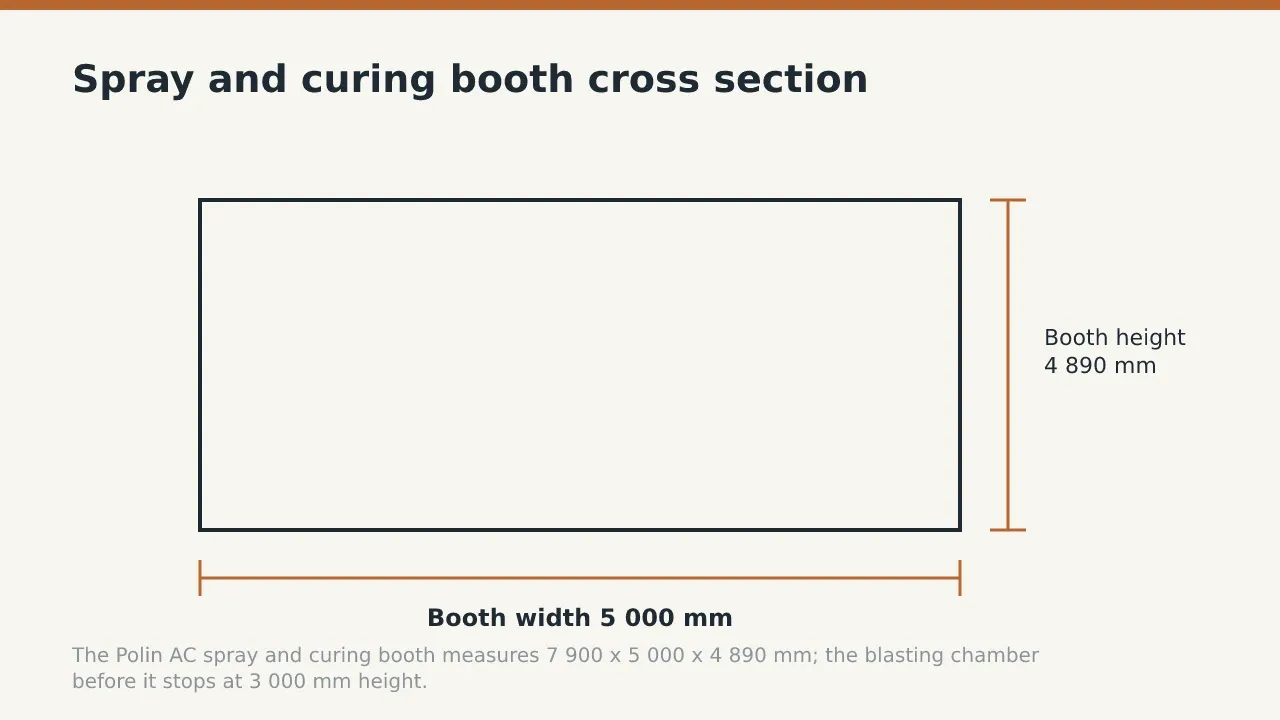
The blasting chamber sets the limit, not the paint booth, as the welded part size range in our gallery shows. The chamber measures 8 000 x 5 000 x 3 000 mm, and the booth measures 7 900 x 5 000 x 4 890 mm.
| Station | Length | Width | Height |
|---|---|---|---|
| Compressed air blasting chamber | 8 000 mm | 5 000 mm | 3 000 mm |
| Polin AC spray and curing booth | 7 900 mm | 5 000 mm | 4 890 mm |
These are room sizes, not part sizes. The blaster and the painter walk around the part and reach every face with the nozzle, so the part must be smaller than the room. Height is the tighter figure. The booth offers 4 890 mm, but the chamber stops at 3 000 mm, so a tall part is checked against the chamber first.
Length is the other check. The dual robotic welding station runs on a 14 m track, so a frame can leave welding longer than the 7 900 mm booth. If your frame is that long, split it on the drawing into bolted sections that each fit. Our engineering support team can place the split where the frame loses the least stiffness. Mark the bolted contact faces that must stay bare.
What 75 to 80 °C does to the paint, and to what is bolted on
Heat speeds the cure. At 75 to 80 °C the film hardens in the booth rather than on the hall floor, so dust and handling marks do not end up in it.
The booth sprays and cures in the same room. The part is not lifted while the film is soft, so the crane slings never touch wet paint.
Everything fixed to the part goes into the booth with it. Seals, cables, sensors, plastic guards and greased bearings see the same 75 to 80 °C as the steel. The steel is not affected at this temperature. The parts fitted to it may be. Fit them after painting, and say so on the drawing.
From blasted steel to cured top coat
Painting starts in the blasting chamber, not in the booth. A welded frame follows this order.
- Blast the weldment in the 8 000 x 5 000 x 3 000 mm chamber until every face shows clean, bare metal.
- Blow off the grit and dust, then mask the machined faces, threads and bores the drawing marks as bare.
- Lift the part into the booth and set it on stands so the underside can be sprayed.
- Spray the primer to the film thickness on the drawing.
- Cure the primer at 75 to 80 °C, with the part standing where it was sprayed.
- Measure the primer film with a thickness gauge before the top coat goes on.
- Spray and cure the top coat the same way, then measure again.
- Remove the masking and inspect the edges, welds and corners, where the film runs thinnest.
What the coating report measures, and what to put on the drawing
The coating report records dry film thickness, measured on the cured coat with a gauge. The inspector takes readings on flat faces, on welds and on edges, and records each coat separately.
The report can only check what the drawing asks for. Write the paint system, the colour, the film thickness for each coat and the faces that stay bare. A drawing that says only "painted" gets a question back, not a price. The same applies to every other note, and the drawing details a fabricator needs to quote are set out in a separate post.
The coating report goes into the same file as the weld records and the certificates that follow a plate from the mill. Your receiving inspector then checks one file against one drawing.
Machine first, then paint
Paint after machining, with the machined faces masked. Paint before machining and the cutter cuts through the film, leaving bare steel around every machined face.
The TOS Varnsdorf WRD15 has 6 200 x 3 000 x 1 600 mm of travel. A frame machined on it is already shorter than the 7 900 mm booth, so machining and painting need no extra split. The sequence for machining a welded frame to size is covered step by step, and the machine limits are on the machining capabilities page.
The booth does not correct a frame that moved during welding. At 75 to 80 °C the paint cures, and the geometry stays as the welders left it. Straightness is settled earlier, in the design choices that control weld distortion.
Before you send the drawing
Check the part against the 3 000 mm chamber height and the 7 900 mm booth length. Mark every face that stays bare. State the paint system and the film thickness for each coat. List the components to be fitted after the cure. The chamber, the booth and the curing temperature are listed with the rest of our blasting and painting capacity.
FAQ
What is the largest part you can blast and paint?
The blasting chamber measures 8 000 x 5 000 x 3 000 mm and the paint booth 7 900 x 5 000 x 4 890 mm. The part must be smaller than both, with room for the operator to reach every face.
At what temperature is the paint cured?
The Polin AC booth cures at 75 to 80 °C. Anything bolted to the part sees the same temperature, so heat sensitive components are fitted after painting.
What does the coating report show?
It records the dry film thickness of each coat, measured with a gauge on flat faces, welds and edges. It checks those readings against the thickness written on your drawing.
Can a frame longer than the booth be painted?
A frame welded on the 14 m robot track can exceed the 7 900 mm booth length. Such a frame is designed as bolted sections that each fit the booth.
Send your drawing with the paint system and film thickness through the quotation page, and we will check it against the booth.