
· 7 min read
Blasting before paint: what happens in the 8 000 x 5 000 x 3 000 mm chamber
A welded frame follows its route from the fitting bay into the 8 000 x 5 000 x 3 000 mm blast chamber. Masking, surface checks and timing there decide how long the paint lasts.
A welded frame leaves the fitting bay carrying mill scale, weld spatter, chalk marks and oil from every hand that touched it. None of it can stay under the paint. The blast chamber is where it comes off. That step decides how long the coating holds, well before a spray gun is lifted.
Whether the part fits the chamber whole
A part is blasted whole if it fits inside the 8 000 x 5 000 x 3 000 mm chamber with room to work around it. A long frame stays in its welded form, with no bolted joint added only to suit surface preparation.
The paint booth that follows measures 7 900 x 5 000 x 4 890 mm. It is shorter than the chamber, so its 7 900 mm length is the figure to design to if the frame is to be painted whole. The booth is taller than the chamber, so the 3 000 mm chamber height sets the limit for tall parts. A frame taller than that can be laid on its side for blasting. The drawing should then show which faces can carry its weight.
| Station | Machine | Working envelope | What it decides |
|---|---|---|---|
| Blasting | Compressed air blasting chamber | 8 000 x 5 000 x 3 000 mm | Largest part blasted whole |
| Painting and curing | Polin AC spray and curing booth | 7 900 x 5 000 x 4 890 mm | Longest part painted whole |
| Boring, large frames | TOS Varnsdorf WRD15 | 6 200 x 3 000 x 1 600 mm travel | Frames machined before blasting |
| Boring, long frames | W200 HINR horizontal boring mill | 8 000 x 3 000 x 1 500 mm travel | Long beds machined before blasting |
For welded machine frames, these four envelopes decide the route from the last weld to the finished coat.
Machine before blasting, or after
Machine first, then blast with the finished faces masked. A face machined after painting leaves bare steel at the edge of every cut, and rust starts there first.
The TOS Varnsdorf WRD15 travels 6 200 x 3 000 x 1 600 mm. A frame inside that envelope is bored after welding and before it meets abrasive, so its bores follow the welded shape rather than the flat plate. The W200 HINR horizontal boring mill travels 8 000 x 3 000 x 1 500 mm. That matches the chamber length, so a long conveyor bed can be bored and blasted without being cut into sections. Both mills are listed under horizontal boring of welded frames with their table loads.
A frame is bored only once it is square, and the design choices that keep it square are set out in welded frame distortion control. The setup on the mill is covered in machining a welded frame after welding.
Which faces stay bare, and how to mark them
Every face that must stay bare is masked before blasting: bores, threads, machined seats and earthing points. Mark each one on the drawing, because an unmarked face is blasted and painted with the rest.
The fitter does the masking by hand. Threads take plugs. Bores take caps. Flat machined faces take heavy tape cut to their outline. Each masked feature adds fitter hours, so mask what the function needs and no more.
A hatched zone with the note NO BLAST, NO PAINT is enough. Sending that note with the enquiry saves a round of questions, as does the rest of the list in what a drawing needs before a quote.
What the frame goes through before paint
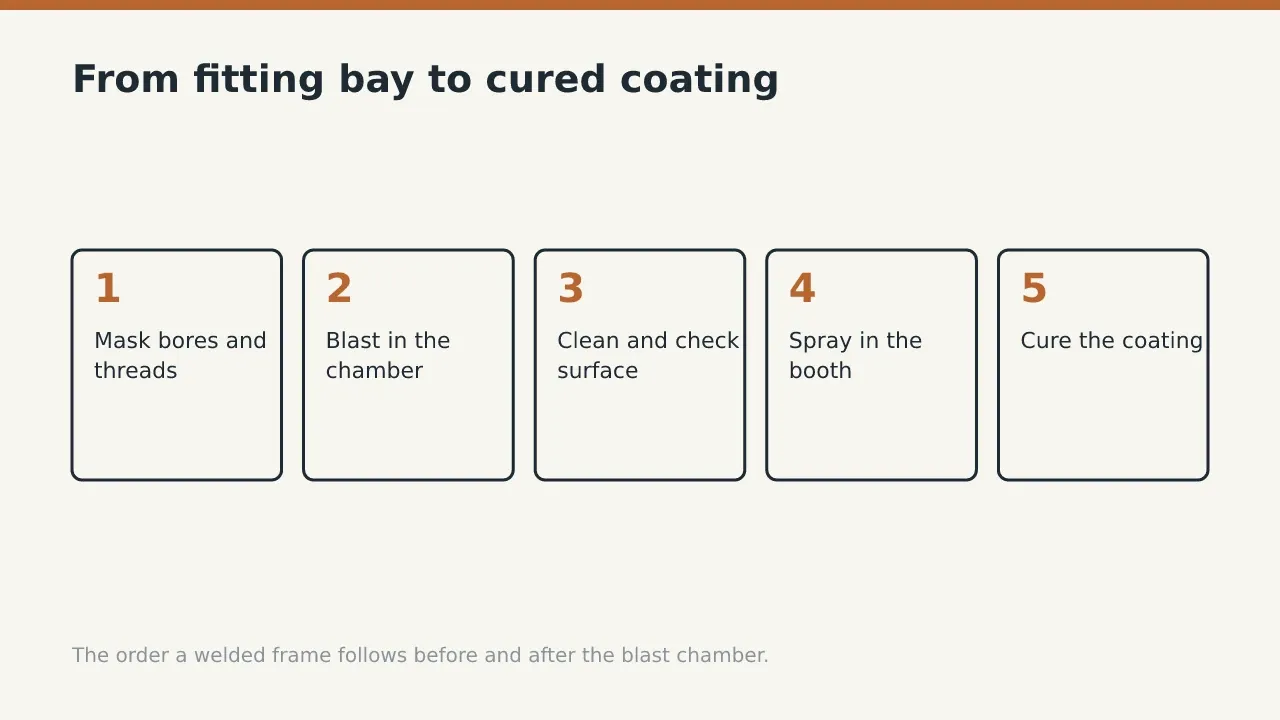
The frame moves through the stations in a fixed order. Each station hands a checked part to the next.
- Lift the frame out of the fitting bay once the welds are inspected and the frame is square.
- Grind off weld spatter and round the sharp cut edges, because paint thins out over a sharp edge.
- Mask bores, threads and machined seats with plugs, caps and tape.
- Set the frame on stands inside the 8 000 x 5 000 x 3 000 mm chamber so that every face can be reached.
- Blast each face with abrasive under compressed air until mill scale and rust are gone and the steel shows an even grey.
- Clean the dust off with compressed air and a vacuum, then compare each face with reference photographs of the specified preparation grade.
- Move the frame into the 7 900 x 5 000 x 4 890 mm booth, spray the coating and cure it at 75 to 80 °C.
The inspector signs the surface check before the first coat goes on. Once paint covers a face, nobody can see what lies under it. The curing cycle that follows the spray gun is covered in curing paint on welded steel parts.
Why the coating's life is set in the chamber
A coating lasts as long as its bond to the steel. That bond is made or lost in the blast chamber, not in the paint booth.
Mill scale left under paint cracks away from the steel as it ages and takes the coating with it. Rust left in a pit keeps growing under the film. Dust on the surface gives the primer something to hold other than steel. Blasting removes all three and roughens the face, so the primer has a profile to grip.
The time between blasting and priming matters for the same reason. Blasted steel takes moisture from the hall air and begins to rust again. Moving the frame from the chamber straight into the booth keeps that interval short. The 75 to 80 °C cure then sets the film before the part leaves the hall, so the frame you receive has not stood bare.
The route is the same for S235 and S355 frames welded in plate up to 40 mm thick. A heavy base and its thin covers get the same preparation, so neither becomes the weak point of the coating. The grade itself is a separate choice, covered in S235 or S355 for a welded frame.
Blasted steel also shows porosity and undercut that a coat of paint would hide. The inspector sees the seams as they are before paint covers them.
What to send so the surface is right first time
Send the drawing with the coating system, the preparation grade and the masked faces marked. If the part comes close to 3 000 mm high or 7 900 mm long, say so. Its orientation in the chamber and booth is then agreed before the steel is cut.
The whole path from plate to truck is set out in the fabrication route for a weldment. The equipment behind each step is listed under steel surface treatment for buyers comparing suppliers.
Mark the bare faces, name the preparation grade and the paint system, and send the drawing for a quotation.
FAQ
What is the largest part you can blast in one piece?
A part that fits inside the 8 000 x 5 000 x 3 000 mm chamber is blasted whole. If it is also to be painted whole, the 7 900 mm length of the paint booth is the limit.
Are machined bores blasted and painted too?
Not if the drawing marks them. Marked bores, threads and seats are masked with plugs, caps and tape before blasting and stay bare.
How is the paint cured after blasting?
The coating is sprayed and cured in the Polin AC booth at 75 to 80 °C. The booth measures 7 900 x 5 000 x 4 890 mm.
Do thick S355 frames need a different blasting route?
No. S235 and S355 frames welded in plate up to 40 mm thick go through the same chamber and the same surface checks as lighter parts.
Send your drawing with the bare faces marked through the quotation page, and the surface route is priced with the rest of the work.