
· 7 min read
6 200 x 3 000 x 1 600 mm of travel: machining a frame after it is welded
Weld shrinkage moves every face near a seam, so bearing seats and mounting faces are cut after welding. Travel, table load and spindle size decide which boring mill takes your frame.
A bearing seat welded to a frame moves when the weld cools. The seam shrinks, the plate pulls toward it, and a face that was flat before welding is no longer flat. That is why faces that carry a shaft, a gearbox or a rail are machined after welding. The frame goes onto a horizontal boring mill as one piece.
Machine the faces before welding or after
Machine them after. A face finished before welding moves with the shrinking seams, and the tolerance on the drawing moves with it.
The welded machine frames built here carry bearing seats, gearbox pads and rail faces that are all cut after the last seam. The shop welds S235 and S355, the ISO/TR 15608 group 1 steels, up to 40 mm thick. For you, that means the plate that carries the load and the bore that carries the shaft come from one hall, under one EN 10204 3.1 certificate.
Good design reduces how far the steel moves. The post on how to keep a welded frame from distorting covers weld sequence and stiffener placement. Machining after welding removes whatever movement is left. The seam sets the shape; the mill sets the dimensions.
Which boring mill the frame goes on
Three values on your drawing choose the mill: the frame's envelope, its finished weight and its largest bore. Two TOS Varnsdorf mills and one long W200 HINR mill cover the range.
| Machine | Travel | Table | Table load | Spindle |
|---|---|---|---|---|
| TOS Varnsdorf WRD15 | 6 200 x 3 000 x 1 600 mm | 1 800 x 2 500 mm | 16 000 kg | 160 mm |
| TOS Varnsdorf WHQ13 | 3 500 x 2 500 x 1 600 mm | 1 800 x 2 500 mm | 12 000 kg | 130 mm |
| W200 HINR | 8 000 x 3 000 x 1 500 mm | not listed | not listed | not listed |
The 6 200 x 3 000 x 1 600 mm travel of the WRD15 decides how many faces are cut in one clamping. Two bearing seats at opposite ends of a frame are bored from the same reference if both sit inside that travel. One reference means the two bores line up without a second setup and the error it would add.
The WHQ13, with 3 500 x 2 500 x 1 600 mm of travel, takes the shorter frames. That keeps the WRD15 free for the long ones and shortens the queue for both.
The table load is the second check. The WRD15 table carries 16 000 kg and the WHQ13 table carries 12 000 kg. A frame under 12 000 kg can go on either machine, which gives the planner two slots instead of one. Put the finished weight on the drawing so that choice is made before the frame arrives.
Both tables measure 1 800 x 2 500 mm. A frame with a larger footprint overhangs the table and needs extra supports, and the planner arranges those in advance.
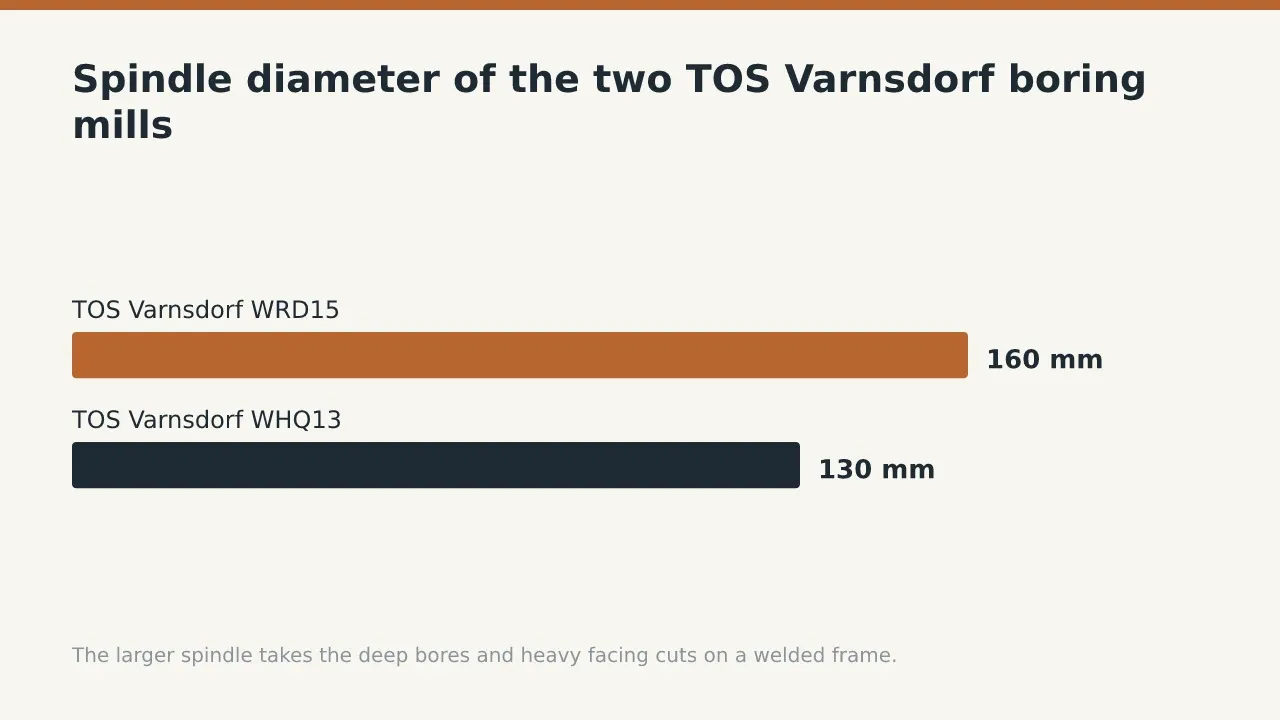
The spindle is the third check. The 160 mm spindle of the WRD15 is stiffer than the 130 mm spindle of the WHQ13. Deep bores and heavy facing cuts therefore go to the larger machine, where the bore holds its line over its full depth.
Frames longer than the WRD15 travel go to the W200 HINR, with 8 000 x 3 000 x 1 500 mm of travel. That length keeps a long conveyor or machine bed in one clamping instead of two. The page on machining capabilities lists the lathes and the gear hobbing machine that finish shafts and gears for the same frame.
From weld jig to finished bore
The order below is the one a frame follows through the hall. It is the machining part of the eight steps from drawing to weldment, shown in more detail.
- Weld the frame complete before any face is machined. Long seams run on the dual robotic station, whose 14 m track covers the full length of a long frame, so a seam is laid without moving the part.
- Measure the welded frame with the FARO Arm Prime 10 measuring arm. The inspector records where each face actually sits and how much stock is left on it.
- Lift the frame onto the mill table and clamp it against the datum on the drawing. The crane driver sets it down on the WRD15 table, rated for 16 000 kg.
- Bore the bearing seats and mill the mounting faces in one clamping. The machinist works from one reference, with the 160 mm spindle on the heavy cuts.
- Measure the machined faces again before the frame is unclamped. A face out of tolerance is corrected on the mill, not after paint.
- Mask the machined faces, then blast and paint the frame. The Polin AC booth cures the coat at 75 to 80 °C, so the paint is hard before the frame is lifted for dispatch.
What the drawing has to tell the mill
Mark every machined face and give it stock. A face drawn at its final size leaves the mill nothing to remove after the weld has moved it.
Name one datum. The machinist clamps to it and the inspector measures from it, so both work to the same zero.
State the finished weight and the largest bore in the title block. Those two values pick the machine before anyone opens the model.
Write the grade in full, because the letters after S235 and S355 change what the steelworks certifies. The rest of the list, from material certificates to paint system, is in the post on what a drawing needs before a quotation.
How you know the bores are where the drawing put them
Ask for the measurement report with the frame. The inspector measures each machined face and bore against the datum, and the values go on paper beside the drawing dimensions.
The measuring arm comes to the frame, so the check happens on the mill table while the frame is still clamped. A deviation found there costs one more cut. The same deviation found at your assembly line costs a return trip.
The report format and the other checks on a frame are described under assembly and inspection on the capabilities pages.
Send the drawing with the machined faces marked, the datum named, the stock stated and the finished weight in the title block. The planner can then name the mill that takes the frame and confirm whether it machines in one clamping.
FAQ
What is the largest welded frame you can machine in one clamping?
The TOS Varnsdorf WRD15 has 6 200 x 3 000 x 1 600 mm of travel and a table rated for 16 000 kg. Longer frames go to the W200 HINR, with 8 000 x 3 000 x 1 500 mm of travel.
Why not machine the parts before they are welded?
Weld shrinkage moves every face near a seam as the frame cools. A face machined after welding stays where the drawing puts it.
How heavy can the frame be?
The WRD15 table carries 16 000 kg and the WHQ13 table carries 12 000 kg. Put the finished weight on the drawing so the planner picks the machine.
How are the machined bores checked?
An inspector measures each bore and face with a FARO Arm Prime 10 measuring arm before the frame is unclamped. The values go into a report that travels with the frame.
What plate thickness can be welded before machining?
S235 and S355 are welded up to 40 mm, and austenitic stainless steel from 3 to 16 mm.
Send your drawing through the quote page with the machined faces marked, and the planner will name the mill that takes it.