
· 6 min read
Welded part size: what 1.1 to 18.9 m in the gallery shows
The published models run from 1.1 to 18.9 m. What each structure group's size band shows about handling in the hall, and why the machines, not the gallery, set the limit.
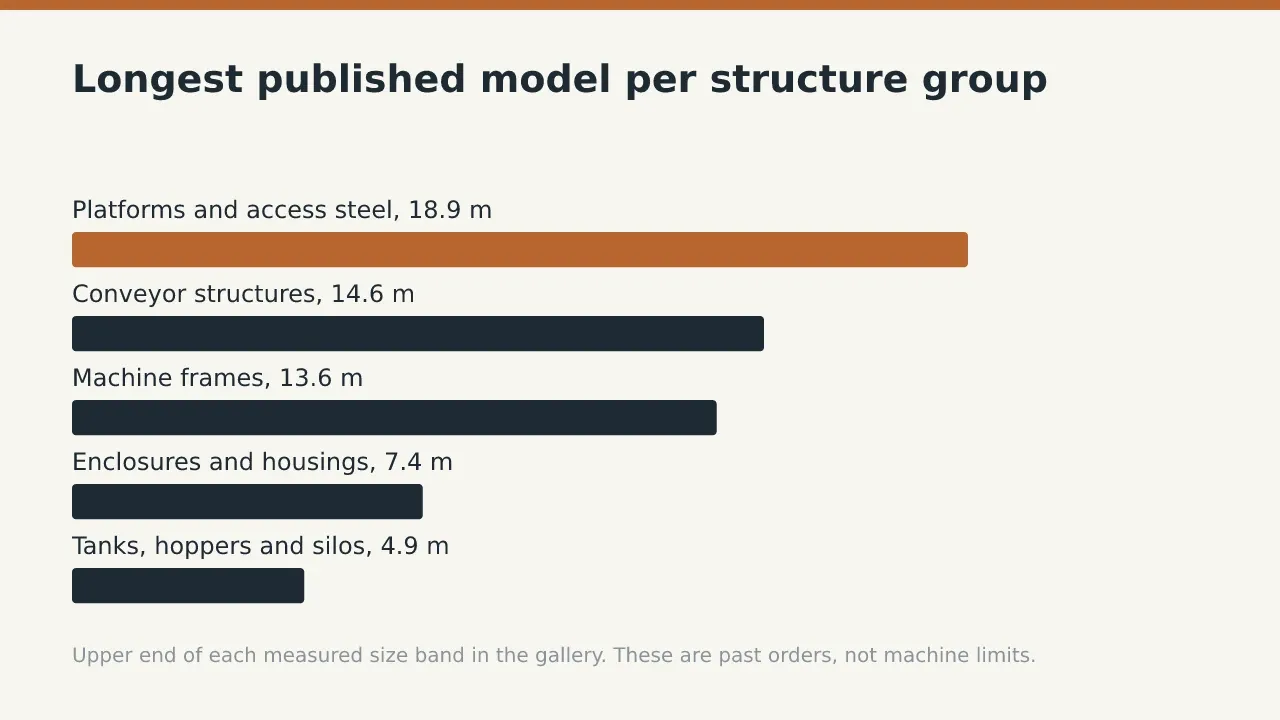
The published platform models in the Tanax Structures gallery measure from 1.1 to 18.9 m. The conveyor structures run from 1.5 to 14.6 m. Tanks, hoppers and silos sit in a narrow band, from 3.3 to 4.9 m. Each band records parts already built and published. It shows how parts of that size move through the hall. It does not mark the largest part the hall can take.
Where your part sits in the measured bands
Find your structure group in the table and hold its band against your drawing. A part inside the band has a precedent in the hall, and a part outside it needs a check, not a refusal.
| Structure group | Published size band |
|---|---|
| Machine frames | 1.5 to 13.6 m |
| Conveyor structures | 1.5 to 14.6 m |
| Platforms and access steel | 1.1 to 18.9 m |
| Tanks, hoppers and silos | 3.3 to 4.9 m |
| Enclosures and housings | 2.0 to 7.4 m |
| Built to drawing | 1.2 to 13.6 m |
The widest band belongs to platforms and access steel, where published models run from 1.1 to 18.9 m. A short landing and a long walkway both have a precedent, so the method is known before the price is. Enclosures and housings run from 2.0 to 7.4 m. That band fits the length of the 7 900 x 5 000 x 4 890 mm paint booth, so length alone never forces an enclosure into sections. A tank that measures 4.9 m on its long axis cannot stand on it in a booth 4 890 mm high. Its lifting lugs belong where it can lie on its side. Machine frames and built to drawing parts both top out at 13.6 m. At that length, the machined faces on a frame decide more than its overall size does.
How a long part moves through the hall
A long part moves between stations on the crane, and every station has a measured envelope. A part that fits each envelope travels in one piece, and a part that does not is built in sections. The crane driver lifts it. The fitter squares it in the jig. The welder joins it, and the inspector measures it before any face is machined.
Following a long frame from plate to paint
- Cut the plates on the TRUMPF laser. Its 2 000 x 4 000 mm bed sets the largest single blank, so a longer flange comes from two blanks or from rolled section.
- Fold the edges on the 400 t press brake, which bends up to 6 050 mm in one pass. A folded edge longer than that needs a joint, and the drawing should show where.
- Weld the long seams on the dual robotic station, which travels along a 14 m track. A frame within that length stays in place while the robots travel along it.
- Measure the welded frame with the FARO measuring arm. The inspector checks the datum faces before any metal is removed.
- Machine the datum faces on the long horizontal boring mill, with 8 000 x 3 000 x 1 500 mm of travel. Faces farther apart than that travel need a second setup, and the tolerance between them should allow for it.
- Blast the frame in the 8 000 x 5 000 x 3 000 mm chamber. Paint it and cure it at 75 to 80 °C in the 7 900 x 5 000 x 4 890 mm booth. The booth sets the longest section that is painted and cured in one load.
Where a part longer than the booth should split
Split it at a bolted joint the design already needs, such as a support leg or a module end. Each section should then fit the blast chamber, which at 8 000 x 5 000 x 3 000 mm is lower than the paint booth. The chamber height, not its length, is the figure to check on a tall platform section, since structure height classes set how it is blasted, painted, machined and loaded.
A shorter weldment also moves less as it cools, which is the point of distortion control in a welded frame. Where machined faces must line up across a joint, the order of welding, bolting and machining sets the tolerance. That order is set out in machining a frame after it is welded, step by step.
Why the gallery is not a capacity limit
The bands record what buyers ordered and what was published, not what the hall can take. The real limits sit in the machines, and each one is measured. The longest published model among the conveyor structures measures 14.6 m, and that figure reflects past orders, not a ceiling. The larger TOS Varnsdorf boring mill has a table rated for 16 000 kg. A heavy base frame is not turned away for its weight alone. The travel and table load of each mill are listed on the machining capabilities page.
What to send with a large drawing
Send the overall size, the weight where known, and the places the part may split. With those three, the method is fixed before the price. The rest of the checklist is in what a drawing needs before a quote. The whole route is laid out in the steps from drawing to weldment.
Mark the possible split points on the drawing before you send it. The quotation then comes back with the section plan, the machines and the price together.
FAQ
What is the longest part in the published gallery?
The longest published model is a platform at 18.9 m, in a band that starts at 1.1 m.
Can you build a part longer than the gallery shows?
Yes. The bands record past orders, and the limits sit in the machines, such as the 14 m robotic welding track and the 7 900 x 5 000 x 4 890 mm paint booth.
What is the largest section that is painted in one load?
The booth measures 7 900 x 5 000 x 4 890 mm and cures at 75 to 80 °C, so a section must fit that envelope. A longer part is split at a bolted joint.
How far apart can two machined faces be in one setup?
The long horizontal boring mill has 8 000 x 3 000 x 1 500 mm of travel. Faces farther apart than that need a second setup.
Send your drawing with the split points marked through the quotation request page, and the section plan comes back with the price.